
 close
close


 LOGIN
LOGINRugby Coach Weekly is the largest digital resource for youth coaches, trusted by 15,000+ coaches, teachers and parents every month.
-
Coach with confidence
-
Improve your teams faster
-
Run great sessions with less effort
- Expert coaching advice from TOP Coaches
- Training sessions for players from U6 to U17+.
Rugby coaching tips to help get your jumpers in the air


In all supported lifting the jumper begins the action with a counter movement, which might be a step in or a small drop followed by a strong extension through the ankle, knee and hip joints.
This gets the jumper moving upward, with the lifters then adding to that upward motion.
The lift
Lineout lifters use the same principles as a weightlifter lifting a bar. They stand close to the weight, but with one foot in front of the other to make it easier to move forward or back at the last moment.
Knees are bent to get the hands to the taped thighs. As the jumper begins to move up, the lifters’ bent arms add to the upward motion. In response to the added weight on the lifters’ arms though, there is a slowing of the lifting movement at the arms and shoulders.
The lower body responds to the increased weight by dropping a little further and the muscles around all the joints involved respond with powerful forces to stop any further downward movement.
The short pause that follows, just as with the weightlifter, provides a moment of strong "isometric" work (the muscles contract without moving, like loading a spring) in the lower body, and serves as a stable platform for the arms and shoulders to work from.
Then, as the arms straighten, the lower body levers continue the powerful upward action and the jumper is hoisted to peak height.
Co-ordination is key to coaching this skill
The lift goes through a co-ordinated sequence of muscle action rather than a single explosive lift.
The sequencing action utilises one of the most important concepts of mechanics: that it requires a force to make a change – the less the change the less force required.
If the lift is performed correctly, the muscles act in sequence and the lifted weight does not pause on its rise to peak height. Any change in upward speed is minimal and the need for violent energy-sapping effort is minimised.
Balance tips
It is essential that all three players are balanced. Lifters may choose to start the lift with one foot behind the other to provide forward and back balance. Or they may begin with their feet wide to provide left/right balance.
Given that the jumper is probably going to step forward or back into the jump, one foot in front of the other is probably the best choice.
The key coaching point is the full extension. While the lifter may be strong, the support must be directly underneath to keep the weight up like the weightlifter’s bar.
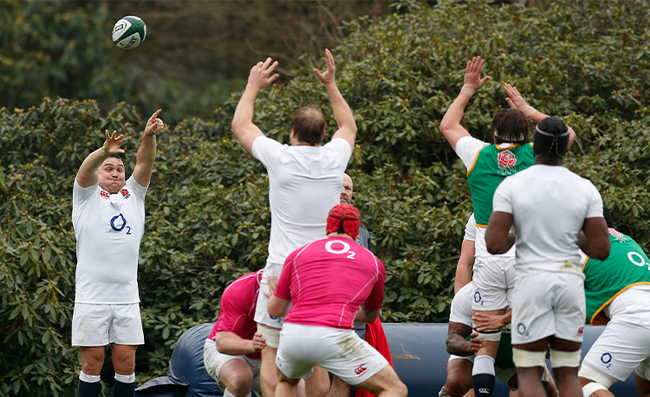
So when peak height position is reached, the feet should be brought to parallel as in the picture below.
With the jumper in the air and balanced (if the front lifter is helping to maintain the balance of the jumper) the weight will be closer to the base of the rear lifter as he is taking more of the weight. The shape will look like an A frame.

Positioning tips
If the lifter stands really close to the jumper before he starts to lift, he is disadvantaged in the arm lift as the angles at the elbow are too tight (the elbows are bent too much).
Similarly, if he stands at an arm’s length, then the muscles in the shoulder are not strong enough to provide any helpful upward force. So, just as in all forceful activities, the angle at the involved joints plays a significant role in the success of the action.
In the action of lifting, the lifter should be close enough so that his elbows are never bent more than 90 degrees, providing maximum mechanical advantage through that phase of the lift.
Click here to order a copy of The Lineout And How To Win It.
Click here for a rugby warm-up drill to practise jumping skills.

Dan Cottrell
Latest Issue

Subscribe Today
Subscribe Today
Newsletter Sign Up


Coaches Testimonials

Colin Shaw

Gary Lee Heavner
Subscribe Today
Latest Issue
Be a more effective, more successful rugby coach
In a recent survey 89% of subscribers said Rugby Coach Weekly makes them more confident, 91% said Rugby Coach Weekly makes them a more effective coach and 93% said Rugby Coach Weekly makes them more inspired.
Get Weekly Inspiration
All the latest techniques and approaches


Rugby Coach Weekly offers proven and easy to use rugby drills, coaching sessions, practice plans, small-sided games, warm-ups, training tips and advice.
We've been at the cutting edge of rugby coaching since we launched in 2005, creating resources for the grassroots youth coach, following best practice from around the world and insights from the professional game.
