Host: Dan Cottrell | Guest: Phil Llewellyn
[Phil Llewellyn]: I’m going to give the four secrets away straight off the bat. We’re going to talk about the end in mind and the game model — they kind of come as one package. What does return to contact look like? And then a little bit about conditioning towards the end and how you build that in.
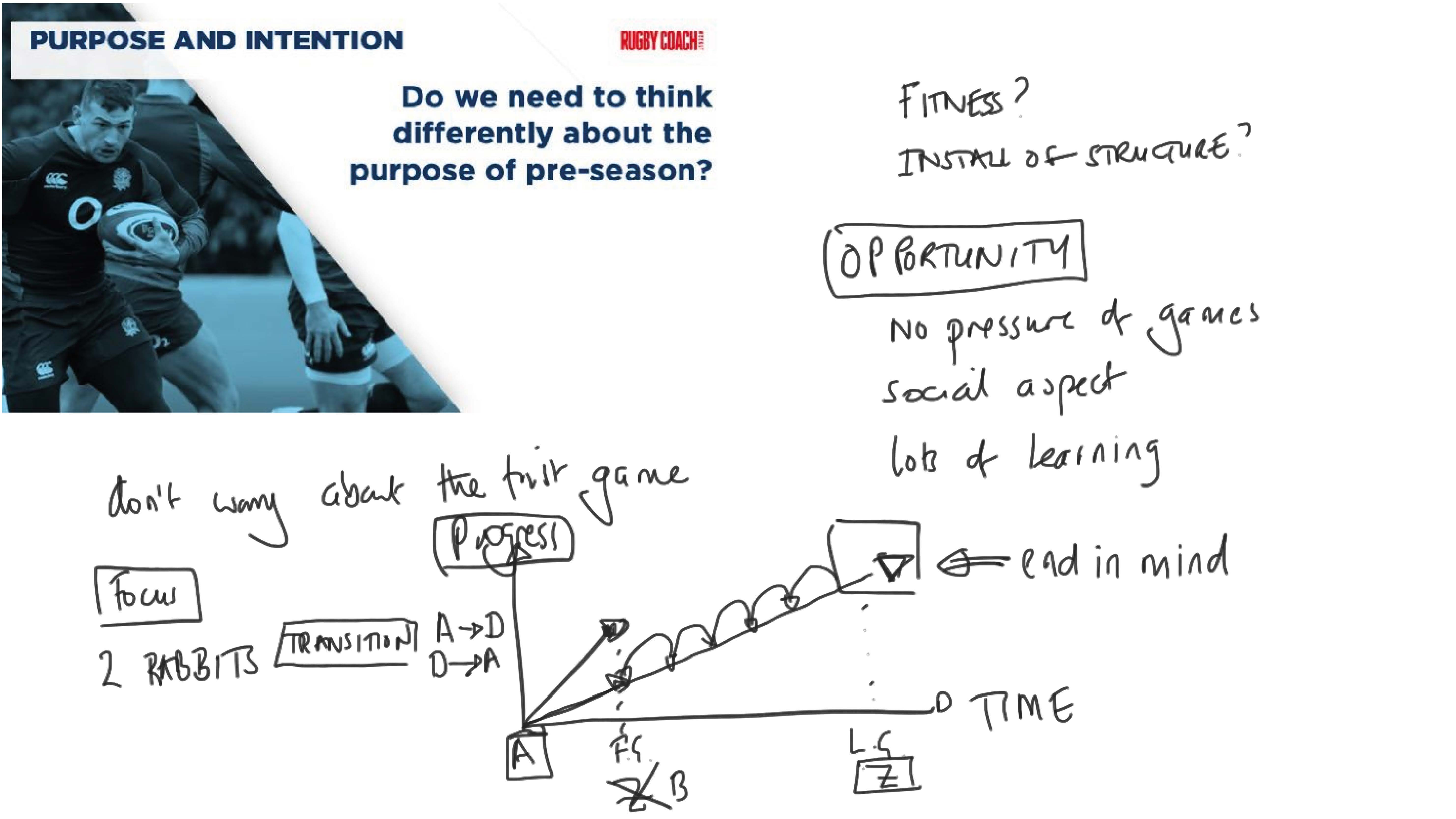
What is the end in mind? Ultimately, I think we’ve got to start preseason planning with: where do we want to go? What do we want to end up doing in terms of how we play, who we are as a squad, what our performances look like?
I’d always frame it as development. You always aim for performance, but we talk a lot about controlling the controllables — what can you manage, what can you do? Because ultimately there are things out of your control. I don’t think we can frame success purely as a result. If all things are equal, you’ve got a 50% chance of winning on any given day. So what can we measure? What can we base our success around?
It’s a useful discussion at some stage in your environment to ask: what are our benchmarks for success? And definitely starting with the end in mind — not just what the coach wants the performances to look like, but what do we as a collective want individual players to be doing?
[Phil Llewellyn]: When I talk about theming, it’s probably more about what are my behaviours as a coach, what is my language as a coach. It’s not necessarily the Crusaders-style storytelling — though that’s awesome and there’s some really good stuff out there, like what David Sharka has done around the Apollo programmes. What I mean by theming is very much: how am I actually approaching my coaching?
I probably need to coach differently with different groups, with different individuals, and also at different times of the season.
[Dan Cottrell]: Can you give me a quick example of a theming situation?
[Phil Llewellyn]: Simply — at the start, do I want a performance focus from minute one? Probably not. A lot of this came from our return to play after Covid. Some of the girls in that squad had played fewer than ten games of rugby in their whole career; others had played for ten years. So at the beginning it was really about reintegration and support — my role was to support, to develop them, to get them back understanding the game. Later down the line it becomes a performance focus: now we want to be nailing our measurables because we want to win the varsity game against Cambridge.
How I act across those two sections of the season is really important. I don’t think I want to be the same coach from minute one to the last minute of the season — that should probably look different.
Bio-psycho-social — how are we supporting the players psychologically, developing and challenging them? Social — not just having a few beers after a game, but how are we developing social cohesion and connection within the squad? Physical development — the conditioning piece. And then what are the on-field deliverables, what does the content actually look like?
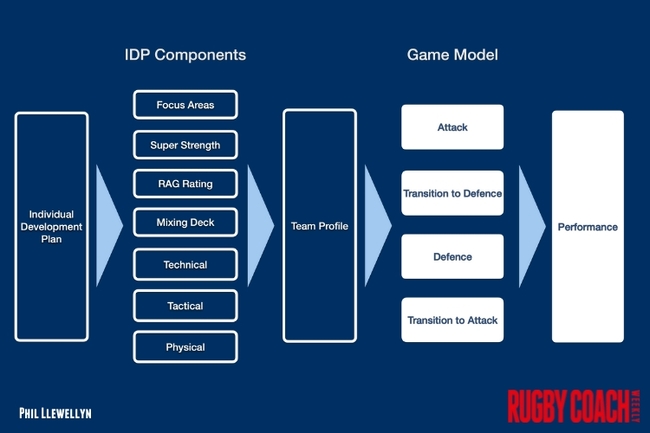
[Phil Llewellyn]: The starting point for me is the individual development plan. The components are: what are their strengths, their super strengths — what are they best at? What are their work-ons? How are we understanding each player?
I think there’s a trap we fall into of focusing purely on what people aren’t good at and want to improve. What are we already good at? How can we keep getting better at the stuff we’re already good at?
This is an opportunity for players to assess themselves. You can spend a lot of time worrying about whether scores are consistent across everybody — I’d take the opposite view. If I’m doing this with you, Dan, I’ll ask you to fill out scores for each area. If your catch is a seven, fine — tell me what your ten looks like. You’ve come up with your own rating system. Tell me why it wasn’t a one. You’ve given yourself a range to work with.
In terms of RAG rating: red means it’s clearly an area that needs development fairly quickly; amber is somewhere in the middle — something you might be pushing on as a strength focus; green might already be a super strength or something we want to turn into one.
One of the challenges of this is that with 30 players, everyone’s scale of zero to ten is going to be different. Some will use their future potential as a ten — how good do I think I can be? Some will use the best player they’ve played with; some will use international players. The scale is going to be different for everybody.
That’s why there’s only one of these sheets and I don’t score it myself. What I want to make sure we do is nail down the fact that your score stays somewhat consistent. If you’re judging it on future potential, that might adapt — you might recognise you’ve got a better future potential than you thought at the start of the season, which is absolutely fine. The whole point is it keeps shifting with you.
[Dan Cottrell]: How does this go out to the players?
[Phil Llewellyn]: It goes out as a PowerPoint — they fill it in and send it back. It just has the date added and becomes a bit of a living document. We’d probably do this three or four times across the season: definitely start and end, and ideally one or two in the middle. We don’t force it on anybody — some players won’t do it, and that in itself is a conversation starter. The ones that are invested get loads from it; others get their development in a slightly different way.
[Phil Llewellyn]: I’d love to say I came up with this myself, but I stole it from Mo Bobat from England Cricket — big shout out to Mo. This is just a thought-provoking exercise. Where are your development needs — are they really precise and specific, or are they pretty general?
If players are fairly experienced rugby players, their development needs are probably quite precise and they know specifically what those are. Some of the players quite new to the game are pretty general — genuinely, we’ve had players come in and not know what the 10-metre line or the 22 is. So we’d just do a quick walk around the pitch. There are also current internationals in the squad with very specific, precise work-ons.
Personal independence is massive — how much do you want me to support you? Are you happy being left alone, or do you need quite a lot of support? Both are fine — it just helps me know. Low personal independence is a real trigger for me not to get frustrated. Some of those players are probably late fairly often, they forget boots or do things that others might get frustrated with. Having this information means I can go: they operate a little differently — how can I help them? How can the other coaches or players help them build some systems to be a little more independent?
Exposure to challenge needs to go alongside the level of support required. If you want to dial up exposure to challenge, you might need loads of support — and I realised fairly quickly that this isn’t just about me challenging someone and leaving them to it. If you’re asking to be challenged, you’re also going to get a lot of support. Low challenge, low support — that probably needs a conversation. Low challenge, high support — that frames where you’re at in terms of understanding, ability, or whatever that might be.
I think this is probably the best one for actually understanding the person. It stimulates conversation, which is really important.
[Phil Llewellyn]: Once we’ve done that with 28 or 30 players, we build a word cloud under tech, tack, physical, and psychological — these are our super strengths, what came back from the squad. The font size went up two to four points for every additional person that mentioned something. Catch and pass was pretty good; competing for the ball; work rate; speed; game understanding — all pretty good. There were some psychological super strengths too, which was probably our biggest finding.
That gave us a real clue: how do we make these strengths in technical, tactical, and physical into bigger super strengths? Then moving into the work-ons — left-handed pass came up, and interestingly catch and pass also appeared as a work-on, which shows the differentiation in the group. There’s a group who think it’s a strong skill and a group who very much want to work on it. Psychologically we identified that we probably didn’t understand it as well as we could — so we brought in a psychologist and tried to pull in more of that. It was a hugely important area.
[Phil Llewellyn]: This is the game model. Ultimately you’re in one of four game states, and the transitions happen pretty quickly: you’re either attacking, transitioning to defence because you’ve lost the ball, defending, or transitioning to attack because you’ve won it.
Outside of that we work with three simple things: what are our principles, what are our intentions, what are our actions?
In attack, our principles were simply: go forward, support, continuity. Our intentions: can we attack the best space, make the best decision, and play with the best ball speed? These are pretty broad overviews — they can mean a lot of different things to a lot of different people, and we didn’t want to be too specific. What’s the best decision is completely subjective, which is kind of the point — you’ve got to be able to say why you thought that was the best decision. And in terms of ball speed, we don’t measure it, but it’s pretty obvious when you watch the video back whether we can get the ball out quicker or present it faster.
For our actions, we focused on scanning and communication — though actually I prefer the word influence. Communication is the huge buzzword: every player knows that if a coach asks a question, saying "communication" gets a big tick. But ultimately communication influences the decisions we make. If I hear the information but it doesn’t influence me — why didn’t it influence me? Was it not good information, or did I just make a different decision?
In terms of attack shapes, I’m not a huge fan of the word structure. We wouldn’t play with what I’d call a telephone number structure — 1-4-3-1, 2-7, whatever people come up with. We just talk about shapes. There’s common language and a common understanding of the shape, but we’re not being really prescriptive about where you need to stand all the time.
[Dan Cottrell]: Just to add — we’ve got two e-learning courses from Jason T and Mike Ashford on game modelling, and a lot of this language is based around that. It doesn’t prescribe how you play, it helps you organise how you want to play. Players still need a shared understanding of what it looks like so they can execute it.
[Phil Llewellyn]: It’s a shared understanding — what are we trying to achieve through our actions and decisions in certain areas of the pitch, without being overly prescriptive. There’s always a choice. You can always kick, pass, or run. Are we aware of what we’re trying to do, who’s making that decision, and why that’s our best decision?
The game model would look the same for transition, for defence, and for transition back to attack.
[Phil Llewellyn]: Within the session there are a few things to consider. This comes from Danny Newcomb and colleagues from their recent book. You’re plotting against cognitive, technical, and emotional. If it’s a session touching all three it lands in the middle of that triangle; if it’s a purely emotional session it’s towards one corner. Just being really intentional with what’s the purpose of the session — it’s not just a rugby session for rugby’s sake.
Then there’s where it sits on the design continuum: executing, exploiting, or exploring. If we’re executing we’re probably in a performance mindset — what is our current best, and are we pushing that envelope? Exploiting might be some more metacognitive work, finding ways to beat the defence, exploring opportunities we’ve created. Exploring is where there are going to be loads of mistakes — someone’s trialling that new out-the-back pass they saw at the weekend, or a crossfield kick with their left foot.
My behaviour needs to adapt as a coach. If we pitch a session as explore, I can’t be criticising mistakes. If we’re executing, I probably need to be a little harsher: why is that going wrong, how can we support you to be better?
This is still a huge work-on for me — I’ve only really come across this in the last eight to ten months. But it’s been really interesting to try and adapt and be clear, and we’d share this with all the players.
[Phil Llewellyn]: This was our 11-week run into varsity. Weeks one to five was what we classed as preseason, and the second six weeks was the season proper. The themes were: exploration, developing, honing, perfecting, performing. Really important language. We shared this with the players, it was on all the session plans, and we defined what each phase looked like in terms of behaviours.
The design continuum is a useful reference point too. An unopposed drill personally I’m not a massive fan of — I don’t necessarily find it hugely beneficial. Most of my practice would sit from a small-sided game up to the macro game level. As anyone who follows Dave Collins on Twitter or the skill acquisition debate will know — this probably comes down to: can you justify why that drill is unopposed? Is there a technical emphasis and limited variability? And conversely, can you justify going to a macro game because it’s a tactical focus with high variability? I don’t think anyone should be saying one is right or wrong. We’ve got to find what works for us.
[Dan Cottrell]: I think the most important thing you said there is intention. If you think about your intention, you’re moving further towards what you really want, rather than just deciding to do an unopposed drill here and a macro game there without thinking about why. That effort goes in, and the players understand you’ve thought carefully about it, they’re part of that process, and they know where they are on the journey.
[Phil Llewellyn]: Danny Newcomb talks a lot about starting with the problem in mind — what do we need to make our players better at, and then what does that look like in practice? For years I’d start with the practice: what practice do I want to design? And I’d end up working backwards to figure out how it would make players better. I’ve had to come at it from a different perspective now, asking: what problems are we going to need to overcome to play the game model we want? And then how does the practice design support that? It’s not listing a load of practices and hoping it’s worked — it’s starting with the problem and constructing a practice that meets that need.
[Phil Llewellyn]: The session plan would show attack and defence or transition, principles, intentions, actions. Players get to see where the intention of the session sits. About 20% of the session would be small-sided games, 10% unit play, 20% variable practice and phase play. But by the time you’ve added in the warm-up, cool-down and other elements, only about 50% of the time on the field is for these practices — which was quite a big eye-opener for me.
This was shared with the players so they understand how they might be challenged — whether it’s more of an emotional, technical, or execute session — and that probably helps them come better prepared.
Our overview for the first five weeks or so — October/November for us — had the first four Monday sessions as revision: just getting back into the game. Wednesdays were about introducing new content; socially it was about integration, getting the squad back together. Psychologically it was around challenge and support — are we challenging them on their IDP and how are we supporting them with that? And S&C — we’re lucky to have access to a conditioning coach.
Preseason for me is never designed in isolation — it has to match up with what we want to be delivering across the whole season. And this isn’t to say none of it is adaptive. Just because it’s written down in August or September doesn’t mean it won’t change. But having a steer means I’m not just being reactive. I’ve worked in a number of programmes where I’d be living Saturday to Saturday — what do we need to fix? But the game is different every week, the opposition is different, the conditions are different. How do we know that what went wrong on Saturday is going to be a problem next Saturday?
Having this longer-term view allows us to get further. Sharing it with the players so they know that over three months we’re going through all these different things — I think that gives them real foresight and helps them understand how they fit into where we’re trying to go as a group.
[Dan Cottrell]: To think that in week one your team will look like it does in week 12 is a mistake. You’re not going to have your full defensive system in place by week one — possibly not even by week six. There’s a certain amount of patience required in this planning.
[Phil Llewellyn]: Absolutely. For most people it’s a 20 or 30 week season — that’s a long time. When do you need to be at your best? Things are always going to be unfinished. If you’ve got a club team this might be a five-year project. Year one of five.
How quickly can people actually improve? The world’s best learners could probably take something from one session. A senior international might improve week to week — otherwise they wouldn’t be a senior international. But come five, six, seven, eight rungs down that ladder to the community game — how quickly do we actually think people can learn and get better? We might be talking six months for a player to genuinely feel they’ve improved something you’ve been working on with them. We need to keep that bigger picture in mind way more of the time.
At Hinckley, when I was head coach, we spent two years doing nothing other than talking about and working on presenting the ball on the floor. We tried everything — endless different ways to develop it, promote it, punish it, reward it. And in two years, did it get a bit better? Probably. Did it get anywhere near where we wanted it to be? Absolutely not. And that’s two years with semi-professional rugby players. Learning and getting better is hard. You’re often undoing bad habits that have built up over years.
[Phil Llewellyn]: A big thing for me was coming across the paper by Hendrickson and colleagues — the Technical Skill Training Framework and Skill Load Measurement for the Rugby Union Tackle. I pulled all the key information into a spreadsheet. They built it off the back of two or three sessions a week, so it needs a little adaptation if you’re only doing one or two, but they basically broke down what type of tackle we want to be making, how many per shoulder, what the rate of contacts per minute should be, what that training needs to look like.
This was a game changer, particularly coming back from the pandemic when a lot of players hadn’t tackled for a long time. It really helped us build up the number of tackles, the proficiency, and the safety.
I do think some people were overly worried about the drop-off in tackling ability. Even in a normal season you’re probably not tackling for three months in the off-season anyway. Extending that from three months to twelve or fifteen doesn’t mean you suddenly got way worse at tackling — there’s going to be a point on the curve where it drops off, but it will plateau. It was more of a psychological thing than a skill or physical thing.
The key message is: little and often. Rather than doing four or five weeks of it and not touching it in the first two weeks, from session one just do something — real low impact. The paper talks about eight reps, four per shoulder, one every 30 seconds. That’s not a lot. It might be static, it might be on your knees, it might just be a shoulder hit without going to the floor. Just do that from the very start and build up from there, whether it’s a breakout skill focus or integrating it into games in later weeks.
[Phil Llewellyn]: Our conditioning coach was a big fan of bookending the session — pre-conditioning and post-conditioning. The reason is that we want to challenge skills under pressure and under fatigue.
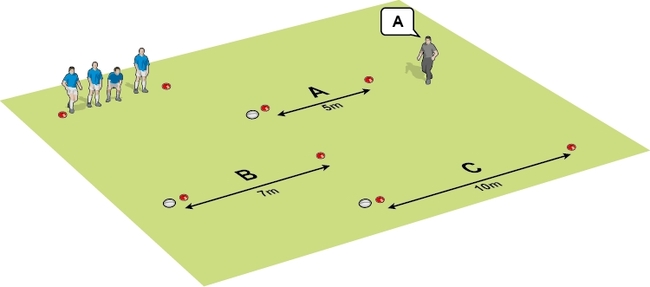
MAS — Maximum Aerobic Speed — is essentially straight-up-and-down running: ten seconds to run your allocated distance, ten seconds off, turn around and repeat. It’s not overly exciting but it’s brilliant in terms of measurability. After maybe three weeks your front five will be at 45 or 50 metres. It never gets easier because your individual or positional distance keeps moving as you progress. But there’s a real visual payoff — four weeks in, I now run 12 metres further than I did four weeks ago. That’s a huge boost for a player.
As we moved through the weeks, we started really pushing high tempo — not just conditioning at the start and end with low intensity in between. By week six we’d have conditioning followed immediately by handling with no recovery — really stretching the ability to handle under fatigue. Then a mid-session conditioning block as well, followed by more handling with no recovery. A genuinely hard block in the middle, some gameplay, and then conditioning at the end.
Another option is to build the conditioning into gameplay. Drop-off touch is a good example — the challenge is that the people who make the most tackles run the most. Our way around that was to number the team: if you make a tackle, the next person in the numbered sequence runs. That way the running stays even, as long as enough tackles are made.
We also used a full pitch length and once you’ve been touched you sprint ten metres. It’s not about steady, casual jogging back — it’s about putting high-velocity metres into the players regardless of position. It doesn’t matter how quick your sprint is; as long as you go flat out for ten, fifteen, twenty metres. You do need a long pitch for this because you eat up a lot of ground. It’s about not just thinking of steady-state running but getting people sprinting, even if it’s just to the touchline and back.
They weren’t huge fans of the straight up-and-down running, the short stuff, the down-ups, the multiple direction work. But ultimately they understand it’s an important part of things because it means they can play the rest of the game at a better tempo. There’s a little bit of a psychological battle in that — and I don’t think that’s a bad thing. Some resilience to get through that type of stuff is exactly what you’re going to need when you get to minute 65, 75, 80 and the game gets hard.
I share all of this with the players — they want to know what’s coming and don’t like it being hidden. Although it was quite funny — they said at one point they just hate seeing it in the session plans. So I put it down as "chocolate tasting and puppy playtime" one week, and the numbers were incredible. Then I told them what it actually was. They said: wait, so there are no puppies? I said: I hate to have lied to you, but no. You can be clever with it. Do whatever works best for the group.
[Dan Cottrell]: Just quickly — what does an emotional session actually look like?
[Phil Llewellyn]: That might be some more physical stuff, things they don’t like, a bit more running they’ve just got to challenge themselves emotionally to deal with. It might be where you disrupt them with bad refereeing, or get someone to be deliberately difficult or penalise things in a nauseous way. Magic Academy would call it creating wobbles — at what point are people uncomfortable, at what point do they start losing their head?
That’s really useful to understand. And then have conversations and find strategies: you were disrupted, you lost your head — how do you get it back? What do you concentrate on? Breathing, removing yourself, calming down — whatever the psychological tools are for re-engaging, managing your temperament.
How often do we address this? How often do we discuss it as a group and build strategies around managing it? The All Blacks are pretty famous for their red and blue thinking — Kieran Read would stamp his feet to feel grounded; others would focus on something in the stadium to re-centralise themselves. It’s just practice — finding what works for you.
We spent a lot of this season on visualisation and breathing: focus on your breathing, let your mind not go blank but just let thoughts travel through without entertaining every one of them. Random thoughts come at completely inappropriate times — you’re meant to be in a performance mindset and you’re thinking about your cat. How do you deal with that? You’re not in control of what you think a lot of the time, so understanding that is pretty crucial.
[Phil Llewellyn]: Great question. You’re definitely doing less structured fitness with younger kids — they’re pretty fit and probably need calming down rather than specific conditioning breakouts. I’d keep that entirely in gameplay for kids. I also think video game design principles really seem to resonate — the levels, challenges, superpowers. You could almost build those off the back of a simplified IDP.
How many kids are good at reflecting naturally? Probably not that many. So how are we posing questions to just start them reflecting — what are they noticing, what do they feel, how does a session feel? How many times do we ask kids a genuine question about how they’re feeling after a session and not just accept "yeah it was all right"? Maybe they keep some notes on one or two things they want to get better at.
If they’re coming into a season where they know 15 or 20 minutes of each session is devoted to their individual development, and you’re using however many coaches you have to support their box kick or left-hand pass or tackle — that’s going to keep them coming back. Kids want to get better at stuff. They want it to be engaging and they want to be challenged.
[Dan Cottrell]: With younger players, preseason isn’t really the same as preseason for seniors — you’re very much in a learning process, using the extra time to do things you can’t do during the season. There’s also a danger that if you spend too much time on macro games and small-sided games, you miss out on the skill work. Players might understand better decisions in a game situation, but if they can’t do a basic pass you’ve got to spend time on that. You need that balance throughout.
[Phil Llewellyn]: Tackling is an interesting one. I probably wouldn’t introduce it as an unopposed drill with tackle tubes. The tube doesn’t move — yes, you can build some confidence by running and hitting something very soft, but the relationship between me and the attacker is the real key element within a tackle. You can be the most confident person tackling a tube and as soon as I ask you to run and tackle a person, your footwork isn’t right and you’ve been stepped because your head’s not in position. That creates false confidence.
I’d be reducing the impact and pace rather than going unopposed — there’s always a scale to consider. With catch and pass you might start unopposed because someone simply can’t physically catch the ball under any sort of pressure and needs a thousand repetitions to build basic hand-eye coordination. But I want to progress that pretty quickly — it’s not a static exercise. I need to be moving up and down that continuum quite a lot, because that’s where I find the stretch point and the confidence builds.
[James (attendee)]: We stopped using tubes for that reason — we’re only using the simulated tackle package.
[Phil Llewellyn]: That would definitely be in line with my thinking. It just doesn’t transition across — it’s not real enough to be of genuine benefit in the long run.
[Dan Cottrell]: We did a very interesting webinar with Omar Mouneimné, the Bristol defence coach — he wouldn’t teach low tackling at younger age groups at all. We’ll be doing an article on that very shortly. And I’m personally not a great fan of kneeling tackles either, for the very reason you’ve just given Phil — players don’t fall in the right way.
Preseason is a great time to start tackling from pretty much day one, but it doesn’t have to be scary. It could just be part of a game — introducing some of the principles of tackling through the footwork and getting close, some wrestling techniques.
[Phil Llewellyn]: Taking the pace out of the game — we’d do walking touch a lot, more for communication than anything else, but for kids you could go to walking shoulder touch: the touch comes when you make contact with your shoulder. There’s no impact, you’re not finishing the tackle, you’re just getting people to understand they need to lead with the shoulder. The best tacklers have the best footwork — coach really good footwork in defence, because that’s how you make good tacklers. And the best decision makers in terms of when to tackle.
[Dan Cottrell]: The game I use for that is walking rugby but we call it ear tackling — you’ve got to get your ear in tight. When your ear goes in, your shoulder has to move with it, so the footwork and head position follow naturally. And it’s about tackling decisions as much as tackling technique.
[Dan Cottrell]: Just to wrap up — there’s a lot of information here which we’ll share. The Hendrickson material is something we also covered in a podcast with Sharif and it’s brilliant — it does need a long lead-in time, and that’s one of the things about preseason: it’s probably wrong to even call it preseason. You’re developing something not just for the start of the season but for the whole season.
Thank you very much to Phil for your time and insight, and for sharing the reality of putting this together.
[Phil Llewellyn]: Thanks Dan, and thanks everyone. I’ve put my email in the chat — if anyone wants to get in touch, I’m happy to hang around and take questions or you can reach me on Twitter or email. I’ll do my best to respond as quickly as I can.


In a recent survey 89% of subscribers said Rugby Coach Weekly makes them more confident, 91% said Rugby Coach Weekly makes them a more effective coach and 93% said Rugby Coach Weekly makes them more inspired.
Get Weekly Inspiration
All the latest techniques and approaches
Rugby Coach Weekly offers proven and easy to use rugby drills, coaching sessions, practice plans, small-sided games, warm-ups, training tips and advice.
We've been at the cutting edge of rugby coaching since we launched in 2005, creating resources for the grassroots youth coach, following best practice from around the world and insights from the professional game.