
 close
close


 LOGIN
LOGINRugby Coach Weekly is the largest digital resource for youth coaches, trusted by 15,000+ coaches, teachers and parents every month.
-
Coach with confidence
-
Improve your teams faster
-
Run great sessions with less effort
- Expert coaching advice from TOP Coaches
- Training sessions for players from U6 to U17+.
Rugby endurance training


The exercise physiologists describe this activity as "intermittent" while coaches describe the training for it as an “interval protocol”.
Whatever name we use it’s just endurance training really, some of you will hate it, but it has to be done because no matter how fast you can sprint, what weight you can lift, or how agile you are, you still have to be able to last the game - and that’s endurance.
You might also find endurance referred to as stamina, but it is aerobic fitness, the ability to run your body on the oxygen you can suck in right now without going into debt.
It is essential for your rugby game and the sooner it becomes a part of your preparation the better.
On the positive side, the physiologists also tell us that as little as 10 minutes of intermittent exercise is sufficient to start making an improvement in your aerobic capacity, so you don’t need to start with a punishing 80-minute programme!
Avoiding boredom
In its most basic form, endurance is long slow distance (LSD) running and there are players who do just that, run for an hour at a very slow pace and benefit from it.
But endurance training need not be that boring. There are many ways you can vary the endurance programme, and you should, because boredom is one of the biggest killers of an exercise routine.
You need to be in this for the long haul, it’s not something that happens overnight. The other killer is over enthusiasm, and there is many a failed athlete out there who destroyed his enthusiasm by trying to do too much in the initial stages of the new programme. So take it easy to start with.
Getting started
If you’re starting your fitness programme from scratch you might begin simply with a run-walk. That is, jog a reasonable distance, then walk the same and do that for up to 20 minutes.
As your aerobic capacity improves, you’ll find you can run further and the walks will get shorter. Soon you will be able to run for 20 minutes without needing to stop at all. At this stage you should start the intermittent exercise programme.
If you like running and being outside then there are a variety of options.
Hill running can be of a “fartlek” type where you run hard up a hill, take a rest to admire the view, coast down an easy slope, jog through the trees, stride out along a cliff top, and sprint home. Next time change all of those. Fartlek means “speed play” and you’re doing just that, playing.
If you’re in a group situation you can organise an orienteering type exercise where you have to check in at certain places and/or bring back information that the organiser knows can be seen. For example: “What colour is the window frame in the cottage at…”.
If you choose to stay in the gym for your training you can incorporate a cardio circuit for the endurance component with three to five pieces of equipment. Let’s say treadmill, versa climber, rower, bike, and elliptical cross trainer.
You might start with a programme of two minutes on pieces 3, 4, and 5 with a one-minute recovery between each machine. Then repeat the sequence but with one minute work and one minute recovery.
If you have three pieces of equipment this equals a 10-minute workout, therefore five pieces of equipment equates to a fifteen-minute workout.
This article is from Rocket Rugby, the ultimate rugby fitness manual containing training programmes to take you through the whole season.

Dan Cottrell

Latest Issue

Subscribe Today
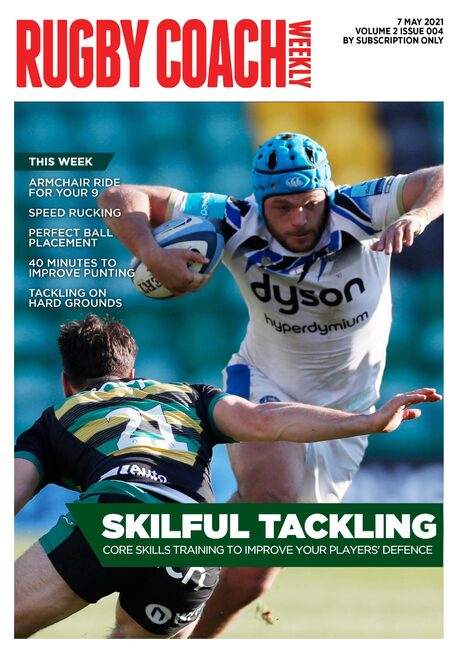
Subscribe Today

Newsletter Sign Up

Coaches Testimonials

Colin Shaw

Gary Lee Heavner
Subscribe Today
Latest Issue

Be a more effective, more successful rugby coach
In a recent survey 89% of subscribers said Rugby Coach Weekly makes them more confident, 91% said Rugby Coach Weekly makes them a more effective coach and 93% said Rugby Coach Weekly makes them more inspired.
Get Weekly Inspiration
All the latest techniques and approaches


Rugby Coach Weekly offers proven and easy to use rugby drills, coaching sessions, practice plans, small-sided games, warm-ups, training tips and advice.
We've been at the cutting edge of rugby coaching since we launched in 2005, creating resources for the grassroots youth coach, following best practice from around the world and insights from the professional game.
