
 close
close


 LOGIN
LOGINRugby Coach Weekly is the largest digital resource for youth coaches, trusted by 15,000+ coaches, teachers and parents every month.
Get access to
- 2000+ drills and games
- 350+ ready-made practice plans
- Expert coaching advice
- Training sessions for players from U6 to U17+.
Five easy steps to set-up fitness tests
Check players’ conditioning progress and measure them regularly in the season.


01 Cooper VO2 max Test
This predicts an athlete’s VO2 max – their endurance capability.
Set-up: Mark out a diamond shape on the pitch, with 50m stretches.
How it works: See how far a player can run/walk in 12 minutes and record the total distance covered. Each lap is 200m.
The best players will be covering up to 15 laps. Split into pairs, so one watches the other run, and counts their laps.
Based on the distance covered, an estimate of the athlete’s VO2 max is calculated thus: (Distance covered in metres – 504.9) / 44.73.
Example: VO2 max = (3400m – 504.9) / 44.73 = 64.72 ml/kg/min.

02 Hexagonal Obstacle Test
This monitors the athlete’s agility.
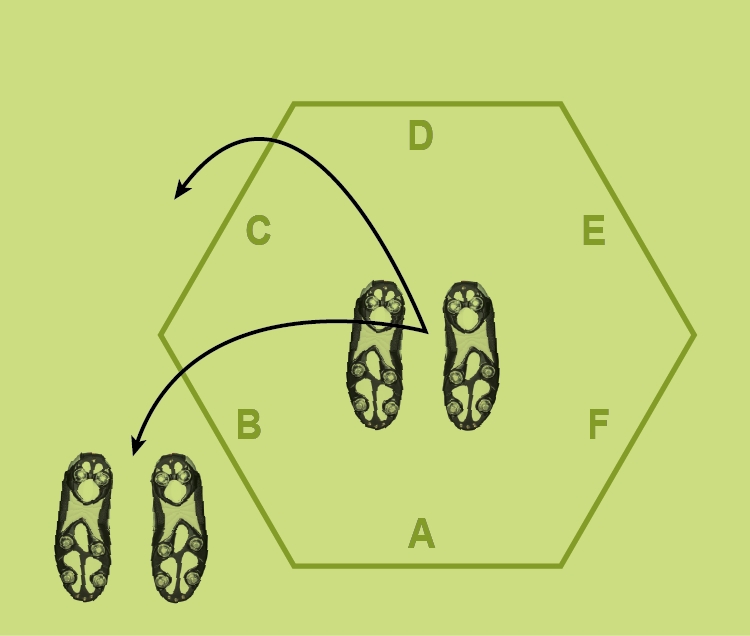
Set-up: Mark out a hexagon with cones, with 66cm (about two foot) between each cone.
How it works: The player stands in the middle of the hexagon, facing line A at all times. They jump with both feet over line B and back to the middle, then over line C and back, then line D, and so on. When the player jumps over line A and back, this completes one circuit.
Complete three circuits and record the time. Rest and then repeat the test. On completion, determine the average of the two recorded times.
If they jump the wrong line, or land on a line, the test is to be restarted. A good score for a 17-year-old male is 11.2 seconds.
03 505 Agility Test
This monitors the athlete’s speed and agility with a 180-degree turn.
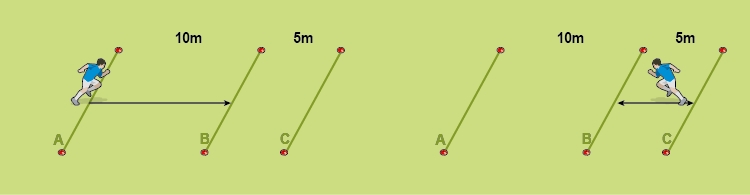
Set up: Mark out a 15m box, with a line 10m into the box.
How it works: The player runs from the start line (A) towards the 10m line (B). As they pass the 10m line (B), the clock starts. They run on to the 15m line (C), turn and run back towards the start line. Stop the watch when the player passes through the 10m line. The best of two trials is recorded.
04 Core Muscle Strength and Stability Test
This can be used to monitor the development of the player’s core strength.
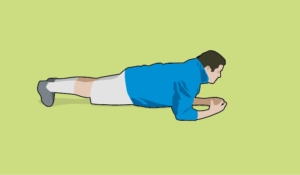
How it works: Throughout the test, the back, neck and head should be maintained in the posture as per the illustration. If the player is unable to hold this position, the test is stopped.
Start them in that position and start the watch. Then...
- Stage 1: They hold this position for 60 seconds.
- Stage 2: They lift their right arm off the ground and hold for 15 seconds.
- Stage 3: They return the right arm to the ground and lift the left arm off the ground for 15 seconds.
- Stage 4: They return their left arm to the ground and lift the right leg off the ground for 15 seconds.
- Stage 5: They return their right leg to the ground and lift the left leg off the ground for 15 seconds.
05 Standing Long Jump Test
This monitors the development of the player’s elastic leg strength.
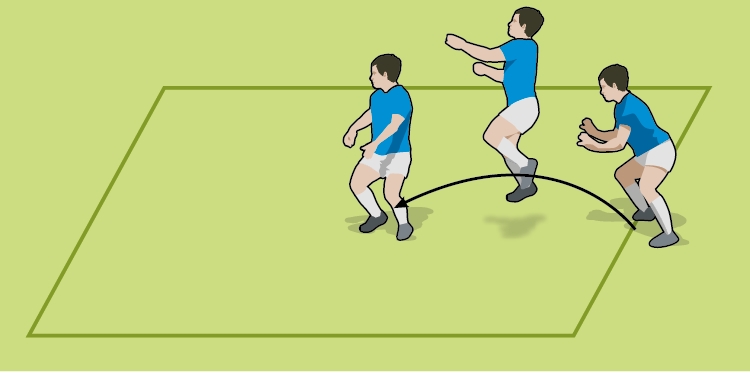
How it works: Place their feet over the edge of the line. They then crouch and leap forward.
Measure from the edge to the nearest point of contact. The start of the jump must be from a static position.
Repeat and then record the best effort.
As with all the data from these tests, use it as a reference point for future tests.
Related Files

Dan Cottrell
Latest Issue
Subscribe Today
Subscribe Today
Newsletter Sign Up
Coaches Testimonials

Gerald Kearney, Downtown Las Vegas Soccer Club

Paul Butler, Florida, USA

Rick Shields, Springboro, USA

Tony Green, Pierrefonds Titans, Quebec, Canada
Subscribe Today
Latest Issue
Be a more effective, more successful rugby coach
In a recent survey 89% of subscribers said Rugby Coach Weekly makes them more confident, 91% said Rugby Coach Weekly makes them a more effective coach and 93% said Rugby Coach Weekly makes them more inspired.
Get Weekly Inspiration
All the latest techniques and approaches


Rugby Coach Weekly offers proven and easy to use rugby drills, coaching sessions, practice plans, small-sided games, warm-ups, training tips and advice.
We've been at the cutting edge of rugby coaching since we launched in 2005, creating resources for the grassroots youth coach, following best practice from around the world and insights from the professional game.
