
 close
close


 LOGIN
LOGINFrom classroom to the field: Retrieval Practice
How evidence-informed approaches can enhance your coaching skills, training sessions and the subsequent development of your players.
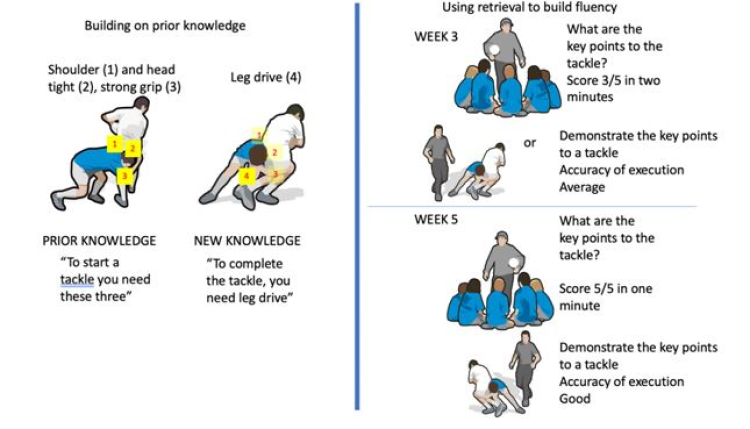
“The most important single factor influencing learning is what the learner already knows. Ascertain this and teach them accordingly."
American psychologist David Ausubel
’Retrieval Practice’ is a buzz term in education right now.
But what is it? How is it helping to improve learning outcomes in the classroom? And how can we utilise it as coaches to enhance the development of our players?
What is Retrieval Practice?
A lot has been written about Retrieval Practice (shortened here to RP) in an educational context.
For this article, I’m going to use Retrieval Practice guru Kate Jones’s definition: "Retrieval Practice is the act of recalling information, embedded in long-term memory, in order to further improve and enhance long-term memory."
What does this mean and why is it important?
There are three reasons why Retrieval Practice benefits learners.
- Learning something new is more likely when linked to what you already know.
- Recalling prior knowledge successfully increases the chance that it can be recalled again far more easily in the future.
- Recalling prior knowledge successfully makes it easier to anchor new information.
How do teachers use this in the classroom?
Before a lesson, a teacher might think about:
- What pre-requisite knowledge do students need to access this lesson?
- What prior knowledge might be relevant to, but not essential for, the learning of this content?
During a lesson, the teacher might use RP in a variety of ways:
- At the start of a lesson, for example, they may use a quick, low-stakes quiz where students are asked to recall pre-requisite/prior knowledge. Sometimes, teachers may provide cues - a word that is likely to trigger student memory - to increase success rate.
- At any point, a teacher might use a planned question that requires students to recall prior knowledge which is relevant to the content about to be taught. Again, this can take many formats - perhaps a ’think, pair, share’ or a ’turn and talk’. Or, alternatively, it can be part of an application task at the end of a lesson, where students are asked to combine prior learning with new content in a variety of ways, like exam questions, essays or something more creative.
After the lesson, as a reflection, teachers should ask themselves:
- Were there any gaps in knowledge? What were they and who did they belong to?
- How will this inform my planning for retrieval in the next lesson and future lessons?
Be a more effective, more successful youth rugby coach
- Win more games, without sacrificing the crucial element of fun
- Develop every player, regardless of vast differences in ability
- Run a respected, professional programme - even with a full-time job and limited time
Subscribe for full access
Or register and unlock 2 free articles,
receive our weekly newsletter, and
get a FREE coaching e-book.
Or if you are already a subscriber login for full access.

Mason Davies
Latest Issue

Subscribe Today
Subscribe Today



Newsletter Sign Up




Coaches Testimonials

Colin Shaw

Gary Lee Heavner
Subscribe Today
Latest Issue
Be a more effective, more successful rugby coach
In a recent survey 89% of subscribers said Rugby Coach Weekly makes them more confident, 91% said Rugby Coach Weekly makes them a more effective coach and 93% said Rugby Coach Weekly makes them more inspired.
Get Weekly Inspiration
All the latest techniques and approaches


Rugby Coach Weekly offers proven and easy to use rugby drills, coaching sessions, practice plans, small-sided games, warm-ups, training tips and advice.
We've been at the cutting edge of rugby coaching since we launched in 2005, creating resources for the grassroots youth coach, following best practice from around the world and insights from the professional game.
