
 close
close


 LOGIN
LOGINRugby Coach Weekly is the largest digital resource for youth coaches, trusted by 15,000+ coaches, teachers and parents every month.
-
Coach with confidence
-
Improve your teams faster
-
Run great sessions with less effort
- Expert coaching advice from TOP Coaches
- Training sessions for players from U6 to U17+.
Unlocking dominance and reducing misses
Defence coach OLI BISHOP uses his experience with the Ealing Trailfinders and RFU Level 4 courses to give a comprehensive breakdown of the tackle phases.


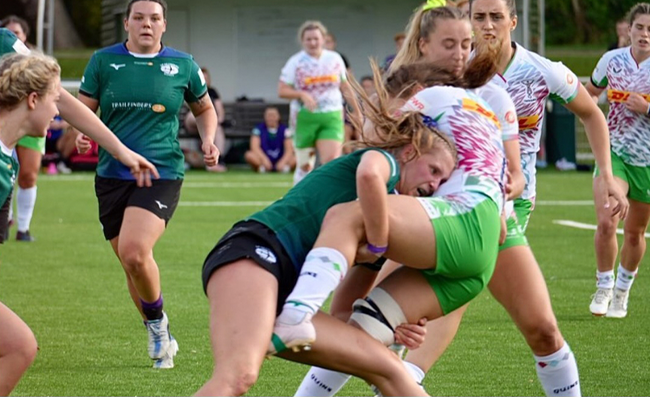
Tackling is a critical skill that not only halts the opponent’s progress, but can also shape the momentum of the game, writes DAN COTTRELL.
Understanding the three phases of a tackle – pre-contact, initial contact, and post-contact – will help achieve dominance and minimise missed tackles.
I spoke to Oli Bishop, who – through his extensive research and experience coaching the Ealing Trailfinders women and RFU Level 4 courses – offered his valuable insights in this crucial area.
1. Pre-contact: setting the stage
The pre-contact phase begins in the engagement zone, typically about five metres between the defender and the ball carrier.
According to Oli, this phase is crucial, as it lays the foundation for the success or failure of the tackle.
He emphasises balance, momentum, and adaptability in this stage, explaining that many tackles are missed due to poor pre-contact preparation.
“For a defender to maintain balance and momentum, their reaction time is critical,” Oli notes.
A balanced stance, often described as a ‘boxer’s stance’, involves keeping feet shoulder-width apart, elbows close to the body and weight distributed forwards to allow quick changes in direction.
“If their hips are behind their feet, their balance is compromised,” Oli adds.
He also highlights the importance of being within two metres of the ball carrier when they receive the ball.
“Your likelihood of dominance or tackle success increases significantly when you’re within that range,” he explains.
This proximity limits the ball carrier’s ability to use footwork or hand-offs effectively, two of the primary causes of missed tackles.
2. Initial contact: the moment of impact
The initial contact phase marks the initial engagement between the defender and the ball carrier.
Oli identifies shoulder placement as a decisive factor. “Aim small, miss small,” he advises, urging defenders to target the top part of their shoulder, just below the neck. This position generates maximum resistance and minimises the risk of high tackles.
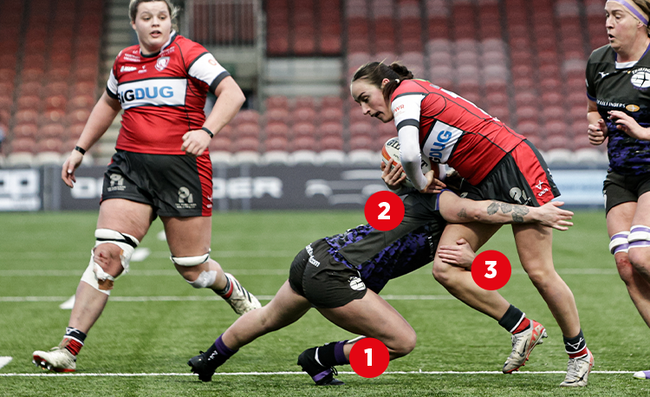
The positioning of the defender’s hands also plays a pivotal role. Oli suggests two approaches:
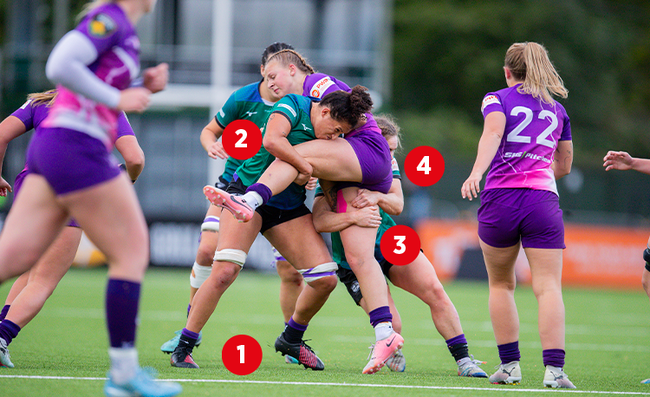
1. Hands behind the knees: This technique destabilises the ball carrier by altering their base of support, making it easier to bring them down. “By pulling behind the knees, you neutralise leg drive, a key contributor to missed tackles,” Oli explains.
2. Hands behind the lower back: This approach, often paired with the ‘ring of steel’ wrap, focuses on controlling the ball carrier’s centre of mass and limiting forward momentum.
Foot placement is equally important. Oli emphasises the ‘same foot, same shoulder’ principle to maintain alignment and prevent the hips from being pushed out during the tackle.
“If your left shoulder hits, and your right foot leads, you’re more likely to push your hips around the ball carrier and lose dominance or miss the tackle,” he warns.
3. Post-contact: finish the job
Contrary to its name, the post-contact phase is far from the conclusion of a tackle.
Instead, it determines how effectively the defender can maintain dominance. Key elements of this phase include:
Arm pull or wrap: Maintaining a tight grip is essential. Oli echoes the “no daylight” philosophy, stressing the importance of pulling or squeezing to keep the ball carrier under control.
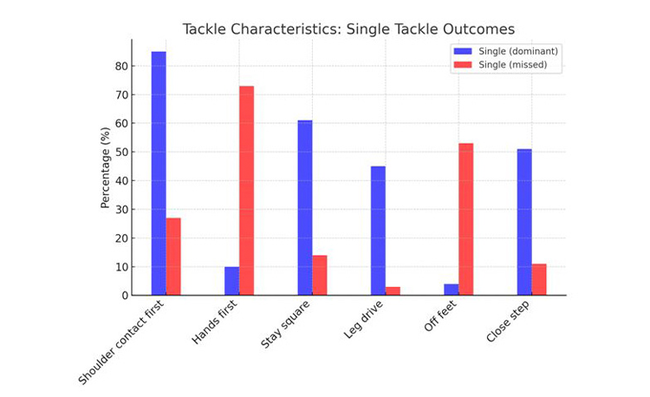
Leg drive: A common error, Oli notes, is defenders going to ground before the ball carrier. “Your second and third steps after contact are critical, if the ball carrier is off balance from the initial contact,” he advises. Without them, the tackle loses power and effectiveness.
Angle retention: Defenders should aim to stay square, or minimally angled, during the tackle. Any deviation, such as hips turning outward, compromises their position and allows the ball carrier to escape.
Oli draws parallels between this phase and a scrum, where hip alignment dictates power and effectiveness. “If your hips push out, you’ve lost the battle,” he states.
Understanding tackle dominance and misses
Oli’s research also sheds light on the metrics for dominant and missed tackles.
A dominant tackle occurs when the ball carrier is pushed backward or redirected by the defender’s force. In contrast, missed tackles fall into two categories:
Contact made, but tackle not completed: The defender fails to maintain control, allowing the ball carrier to break free.
No contact made: Often a result of system errors or poor decision-making, this type of missed tackle can expose weaknesses in defensive structures.
To achieve dominance, Oli advocates a tailored approach, based on player characteristics. “Not every player has the same capacity for dominant tackles,” he says.
Smaller players might excel in low tackles aimed at destabilizing the ball carrier’s legs, while larger players might focus on torso tackles to shift the centre of mass.
Related Files
Coaching insights
Oli underlines the importance of individualised coaching and progressive drills – “Good defenders are confident defenders,” he says.
By building mastery in controlled environments, and gradually introducing complexity, players can overcome technical and psychological barriers.
Oli also emphasises the importance of understanding attacking systems – “More than 85% of the time, teams execute fewer than two passes per phase,” he notes.
Anticipating patterns and positioning accordingly can dramatically improve defensive outcomes.
Conclusion
The three phases of tackling – pre-contact, initial contact and post-contact – are integral to achieving dominance and avoiding misses.
By focusing on balance, technique, and adaptability, players can optimise their performance in each phase.
As Oli summarises, “Tackling is a dynamic process. Success lies in preparation, execution and the ability to adapt in real-time.”
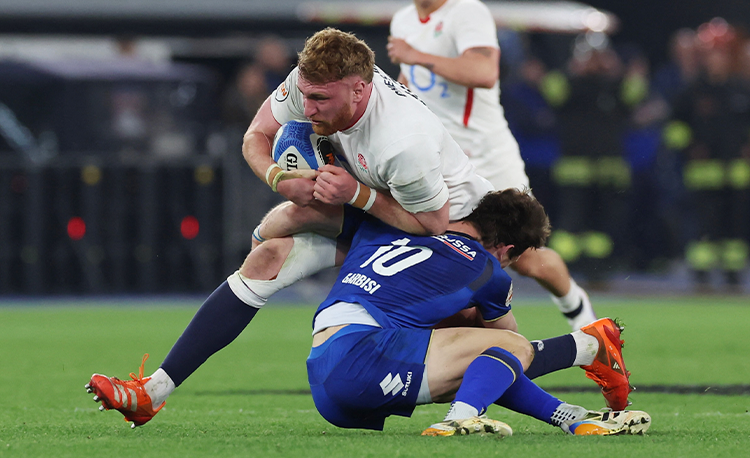
THIS CLIP shows a player making a tackle with their hands behind the knees of the ball carrier. Though the foot placement isn’t great, you can make a dominant tackle if you get your hands in the right place and have enough impulse in the initial contact

Dan Cottrell
Latest Issue

Subscribe Today
Subscribe Today
Newsletter Sign Up
Coaches Testimonials

Colin Shaw

Gary Lee Heavner
Subscribe Today
Latest Issue
Be a more effective, more successful rugby coach
In a recent survey 89% of subscribers said Rugby Coach Weekly makes them more confident, 91% said Rugby Coach Weekly makes them a more effective coach and 93% said Rugby Coach Weekly makes them more inspired.
Get Weekly Inspiration
All the latest techniques and approaches


Rugby Coach Weekly offers proven and easy to use rugby drills, coaching sessions, practice plans, small-sided games, warm-ups, training tips and advice.
We've been at the cutting edge of rugby coaching since we launched in 2005, creating resources for the grassroots youth coach, following best practice from around the world and insights from the professional game.
