
 close
close


 LOGIN
LOGINRugby Coach Weekly is the largest digital resource for youth coaches, trusted by 15,000+ coaches, teachers and parents every month.
Get access to
- 2000+ drills and games
- 350+ ready-made practice plans
- Expert coaching advice
- Training sessions for players from U6 to U17+.
What we can all learn from Bath Academy
DAN COTTRELL explains how their methods can inspire and inform coaches at every level, with valuable insights from CRAIG LILLEY, Bath’s head of academy.


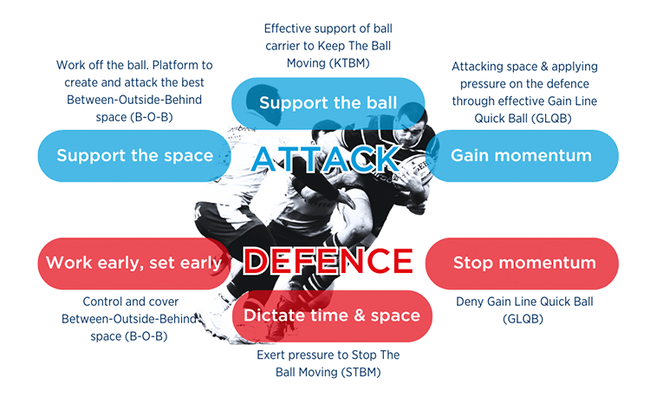
BATH ACADEMY GAME MODELEverything in the model is underpinned by understanding momentum, like the speed of the ball, gain-line success and pitch position in attack and defence.
If you are coaching one theme, there is always an opposite side of the ball – for example, gain momentum vs stop momentum. |
1. importance of alignment
One of Lilley’s early observations, when he was a school’s director of rugby, was the lack of alignment among coaches.
Each coach approached sessions differently, leading to inconsistent messaging for players.
This was despite discussing the whole school direction at the start of the term, and planning together as a coaching group each week.
Bath Academy has addressed this by introducing a game model to align all coaches under two main shared principles.
- Unified language: Coaches follow consistent terminology for key concepts, ensuring clarity across sessions.
- Opposing principles framework: Attack and defence principles are structured to mirror each other – e.g., ‘gaining momentum’ in attack versus ‘stopping momentum’ in defence.
“I’d have a group of coaches, and they’d all be coaching different things in different ways,” explains Lilley.
“That’s why alignment became so crucial to me as a principle.”
By implementing this system, Bath Academy has achieved consistency across age groups and in the transition from youth to senior levels.
This alignment ensures that the players are not confused by conflicting instructions or terminology as they progress.
Bandwidth
While the coaches are closely aligned, with a clear game model and consistent language, Lilley is keen to emphasise that there is bandwidth for delivering sessions.
The coaches are encouraged to be flexible and creative in their approach based on the players in front of them and their stages of development.
Key takeaways
- Ensure alignment by creating a shared game model and a clear communication framework among your coaching team. Review and refine this framework regularly to meet the evolving needs of your players.
- A shared game model doesn’t have to be too complicated to start with. Use these three starting points as a template: in possession in attack; out of possession in defence; and gaining possession from set piece. Then, sketch out three or four pieces of key language that you use. For example, for the attack: Rucks – fight to the ground and snap back. Second phase – quick ball, play at least two passes from the ruck.
- Build piece-by-piece as you introduce the language in each session. Check the language with the coaching staff each week to see if they are still happy with it.
2. Spiral Curriculum for Progressive Learning
The Bath Academy’s curriculum revisits core principles at increasing levels of complexity as players progress through age groups.
Using support space as an example:
- At age 14: Focus on basic principles, such as full-width field coverage.
- By age 18: Incorporate advanced formations, like 1-3-1 systems.
This spiral curriculum enables players to deepen their understanding, while building on prior knowledge.
Lilley explains: "Supporting space at under-15 focuses on full width. By under-18, it evolves into having two sides of attack, or multiple layers of attack."
This approach ensures that foundational skills are never overlooked, while providing a clear technical and tactical growth pathway.
Players gain confidence as they revisit familiar concepts, now with additional layers of complexity.
Key takeaways
- Develop a curriculum that builds progressively on foundational skills and concepts, tailoring it to players’ developmental stages. Use consistent themes and revisit key principles regularly to reinforce understanding.
- For example, in week one of a cycle, you might be working on securing quicker ball at the ruck. You revise the skills already covered. You might add an additional technical point. You practise it in different scenarios.
- Four weeks later, you revisit the same skill. Perhaps this time you don’t need to add more technical information. Instead, you have a more varied diet of scenarios, matching the pressure they might receive in the game.
- In another four weeks, you return to the same idea. The pattern is that you retrieve skills, put them under pressure, and add in decision-rich environments that they might be facing in the game.
- Mix into this what are sometimes called ‘primers’. These can be low-pressure, low-stakes activities just to keep reminding the players of their core skills. Don’t be surprised to see some basic techniques fade over time if you are not spending time revisiting them.
Related Files
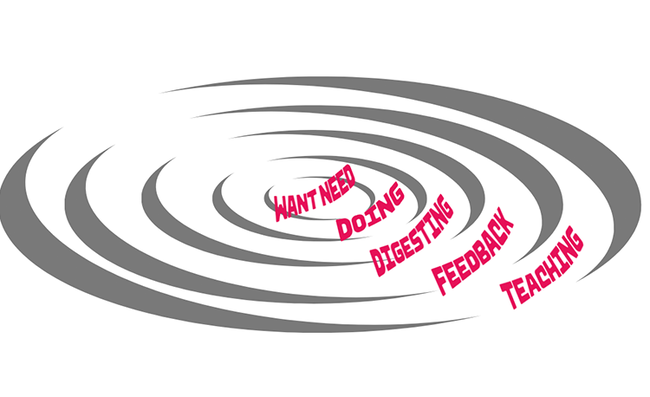
Ripples in the Pond: Doing, Digesting, and Providing Feedback
The overall idea is that coaches should design learning experiences with these factors in mind, to create an effective learning environment.
Learning isn’t straightforward – it flows like ripples, moving back and forth, as learners gradually improve through repeated practice and understanding.
Wanting/needing to learn
The learner must want to learn, or they should be guided to understand why needing to learn is important. For example, a player who prefers ball carrying must see how passing can improve their opportunities to ball carry more effectively.
Doing
Learners need to actively practice what they are trying to learn. For example, if a player wants to improve passing the ball with their weaker hand, they need to practice this skill regularly.
Digesting
Players should also understand why they are learning a skill and the benefits it provides to them. This sense-making then helps them to see how that particular skill will be useful in the future.
Feedback
Feedback is key and can come from the learner themselves, peers, or a coach. It helps refine the learning process and clarify areas for improvement.
Teaching others
Being able to teach the skill to someone else demonstrates mastery.

Craig Lilley
Latest Issue

Subscribe Today
Subscribe Today

Newsletter Sign Up


Coaches Testimonials

Colin Shaw

Gary Lee Heavner
Subscribe Today
Latest Issue
Be a more effective, more successful rugby coach
In a recent survey 89% of subscribers said Rugby Coach Weekly makes them more confident, 91% said Rugby Coach Weekly makes them a more effective coach and 93% said Rugby Coach Weekly makes them more inspired.
Get Weekly Inspiration
All the latest techniques and approaches


Rugby Coach Weekly offers proven and easy to use rugby drills, coaching sessions, practice plans, small-sided games, warm-ups, training tips and advice.
We've been at the cutting edge of rugby coaching since we launched in 2005, creating resources for the grassroots youth coach, following best practice from around the world and insights from the professional game.
