 close
close


 LOGIN
LOGIN


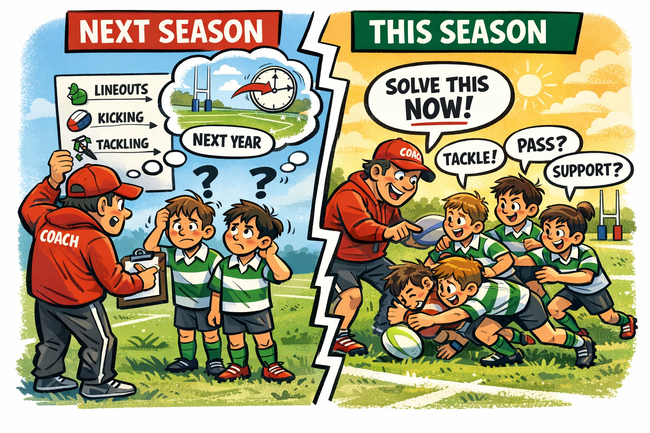
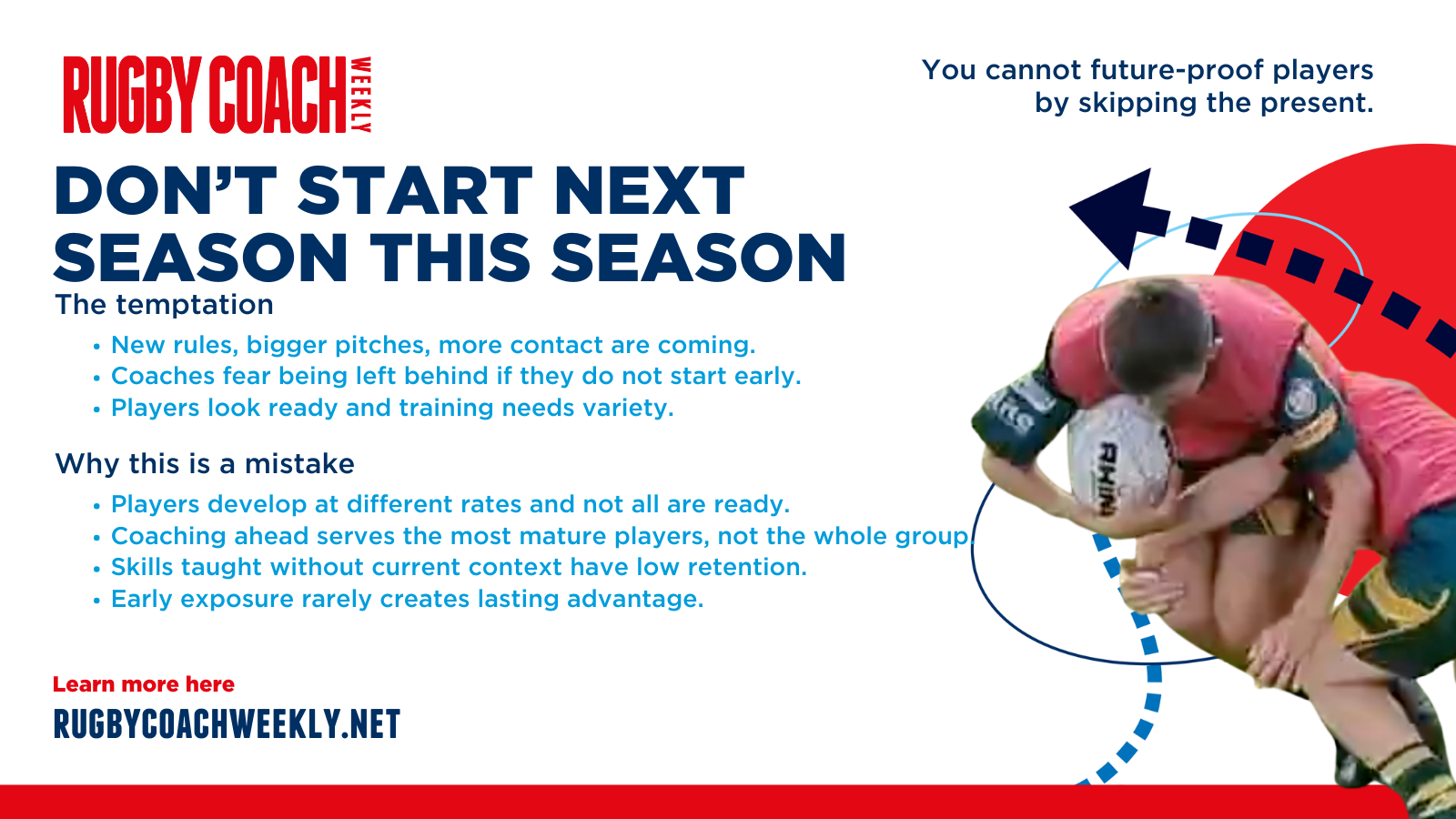
It is so tempting.
New tactical challenges are coming next year. Wider pitches. More players at the ruck. Lineouts. Kicking. And at U8s moving into U9s, tackling.
It is tempting because you are excited about what it unlocks.
It is tempting because you worry that everyone else will get there first.
It is tempting because training needs freshening up and your players look ready.
But my advice is simple. Don’t.
Some players are ready. Many are not.
Within every age group, physical, cognitive, and emotional development varies wildly. We do not bio-band players, so the gap between those who cope easily with increased demands and those who are still grappling with the basics is unavoidable.
A few players may look comfortable stepping into next year’s game. Others are still learning how to solve this year’s problems.
If you start coaching ahead, you are effectively designing sessions for the most ready players and hoping the rest catch up. Many do not. They fall behind quietly, lose confidence, and disengage.
The irony is that there is still huge depth to explore within the current age group rules. The game already contains a tactical spiral. Space, time, pressure, support, and decision-making are all present. They just look different.
You will not be left behind
This is the fear that drives most coaches to jump early. “If we don’t get ahead now, won’t we fall behind?”
Nope.
And here is why.
Key point: Time spent on next year’s tactics before players are living in that game has only a marginal impact. Players cannot properly understand, retain, or apply tactics they are not yet experiencing regularly.
Those skills only become meaningful once the season is underway and the problems are real. Before that, they are abstract ideas with no urgency attached.
The same applies technically.
Four hours of tackling or ruck work in March or April fades long before full contact returns in August or September. A well-designed pre-season will get players competitive far more effectively than trying to sneak next year’s skills into this one.
Once the season is in full flow, teams tend to equalise quickly anyway. Some teams win more games because their players are stronger or faster. That is not a training programme advantage.
Early exposure does not equal long-term advantage
In the grand scheme of a player’s rugby life, early exposure to next year’s skills makes little difference. Others catch up quickly once the environment demands it.
If a player spends the off-season throwing a ball with siblings, watching rugby on television, climbing, running, and being active, they will return more skilful. That development happens regardless of what you squeeze into training.
You are unlikely to manufacture a meaningful advantage by rushing ahead.
Keep training hard without jumping forward
This does not mean training should stand still.
Instead of changing the game, change the challenge.
- In tag rugby, narrow the pitch. Change numbers. Add time pressure.
- At U13s, rather than widening the pitch, reduce numbers.
- Increase decision density rather than adding new laws.
The game becomes harder without becoming different.
For most players, rugby is a series of small tactical problems repeated over and over, regardless of age once full contact rugby begins.
- Shall I pass?
- Shall I step into space or tackle now?
- Shall I support the ball carrier or the next receiver?
- Shall I compete at this ruck or reload?
- Shall I hold this space in defence or fold?
These questions exist at every level. The context changes, but the problems do not.
Finish this season properly
The best preparation for next season is not starting it early. It is finishing this one well.
Master the current demands.
Build confidence now.
Solve today’s problems properly.
Next season will arrive quickly enough.
Evidence base behind this approach
The advice to focus on the current season rather than coaching ahead is supported by research across learning science, youth development, motivation, and skill acquisition.
- Learning is most effective when it solves immediate problems. Motor learning research indicates players retain skills better when practice is tightly connected to the challenges they are currently facing, rather than hypothetical future demands.
- Youth development is non-linear and unpredictable. Talent development research shows players progress at different rates (especially around growth and adolescence), which makes “coaching for next year” a poor fit for many in the group.
- Future readiness is built by mastering current fundamentals. Expertise research consistently finds that high-quality repetition of core skills under appropriate challenge is a stronger driver of long-term improvement than skipping ahead to more complex content.
- Motivation depends on feeling competent now. Self-determination theory shows confidence and persistence increase when players experience clarity, competence, and success in the present, rather than feeling that meaningful progress is always deferred to later.
- Skills emerge from interaction with the current environment. Ecological dynamics supports the idea that players adapt best to the problems they experience regularly. Training for environments they are not yet playing in reduces transfer.
Common research anchors for these ideas include: Wulf (motor learning and attentional focus), Côté (youth sport development), Ericsson (expertise and deliberate practice), Deci & Ryan (self-determination theory), and Davids (ecological dynamics).
In short: the most reliable way to prepare players for future rugby is to help them become highly competent, confident problem-solvers in the game they are playing right now.