
 close
close


 LOGIN
LOGINRugby Coach Weekly is the largest digital resource for youth coaches, trusted by 15,000+ coaches, teachers and parents every month.
Get access to
- 2000+ drills and games
- 350+ ready-made practice plans
- Expert coaching advice
- Training sessions for players from U6 to U17+.
Using constraints to beat a blitz defence
Develop your players’ skills within a game-realistic context. By CHRIS STABLER


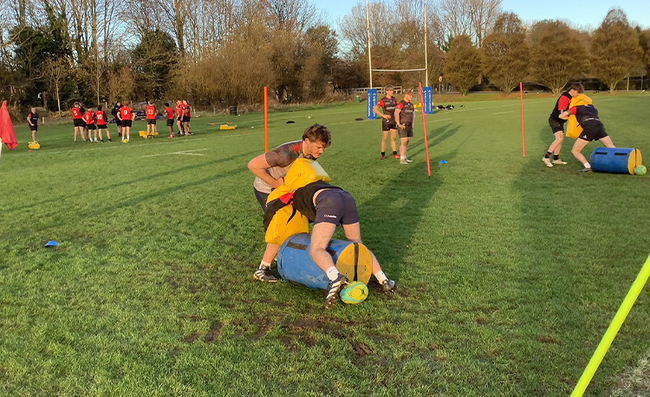
In this article, I outlined the theory behind the constraints-led approach to coaching, where skills are learned and developed within the context of the game.
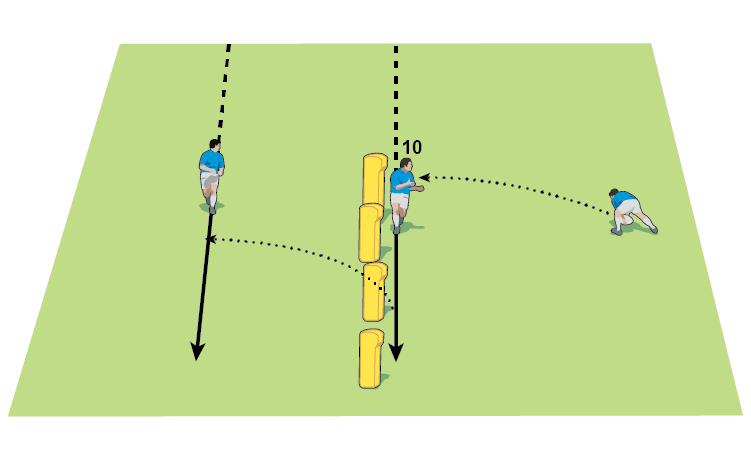
Below is a sample session plan used in an U16s academy session, to break down a hammer/blitz defence and focus on tactical skill acquisition.
The plan incorporates three sections:
1. The initial plan with a framework of options.
2. A series of feedback techniques that can be used by the coach, or are likely to be used intrinsically by the players.
3. Some expected or possible outcomes that the players may generate to achieve the session aims.
This plan allows the coach to facilitate without leading, and gives the players a high degree of ownership regarding the content and outcomes of the session.
Based on the existing knowledge of the needs and abilities of the players, the coach can direct and intercede at any point to maintain focus and progress within the session.
Players come up with outcomes they want to achieve, success criteria to judge progress, and quick prompts they want to hear from the coach to maintain technical and tactical skill focus.
Session |
Two |
Focus |
Constraints led, self-directed session |
Age |
U16 academy session |
Aim |
Self-directed aims proposed by players, based on the purpose of the session |
Purpose |
Tactical attack focus – Breaking down a defensive strategy – Hammer/blitz |
Warm Up (self-organise) |
||
|---|---|---|
Initial plan |
||
|
Guided discovery phase
1. Introduction and outline key purpose 2 mins 2. Straight into a non-conditioned game: Two-handed touch – pop or place (players 3. Teams then break off to discuss outcomes and establish feedback 2 mins 4. Establish outcomes, quick prompts ‘in situ’ and success-criteria targets 5. Coach introduces constraints 2 mins
Self-directed phase
6. Players return to game, with constraints on defence – three ‘downs’ per attack, to maximise attack time 7. Based on the outcome of the game: Have we been successful? Why not? Explore decision-making, core skills and alignment 8. Based on the outcomes from the game, the players then decide whether to 9. Continue with conditioned game with additional self-directed constraints to |
||
Intrinsic/extrinsic feedback techniques |
||
|
Self-determined success criteria
Open questioning: Perceived challenges and possible solutions Posed questioning: How did that feel?; What if...?; How might...?; Evaluate the impact of... Quick prompts ‘in situ’, based on player aims: e.g. hips square, footwork, target hands Freeze/rewind (20 secs max): Pose issues and allow players to identify solutions Optional session content: To meet demands of the session aims |
||
Possible outcomes suggested by players |
||
|
Related Files

Chris Stabler
Latest Issue
Subscribe Today
Subscribe Today

Newsletter Sign Up

Coaches Testimonials
Gerald Kearney, Downtown Las Vegas Soccer Club

Paul Butler, Florida, USA

Rick Shields, Springboro, USA

Tony Green, Pierrefonds Titans, Quebec, Canada
Subscribe Today
Latest Issue
Be a more effective, more successful rugby coach
In a recent survey 89% of subscribers said Rugby Coach Weekly makes them more confident, 91% said Rugby Coach Weekly makes them a more effective coach and 93% said Rugby Coach Weekly makes them more inspired.
Get Weekly Inspiration
All the latest techniques and approaches


Rugby Coach Weekly offers proven and easy to use rugby drills, coaching sessions, practice plans, small-sided games, warm-ups, training tips and advice.
We've been at the cutting edge of rugby coaching since we launched in 2005, creating resources for the grassroots youth coach, following best practice from around the world and insights from the professional game.
