
 close
close


 LOGIN
LOGINWhat? No defenders?
Editor Dan Cottrell adds further context to two sessions.

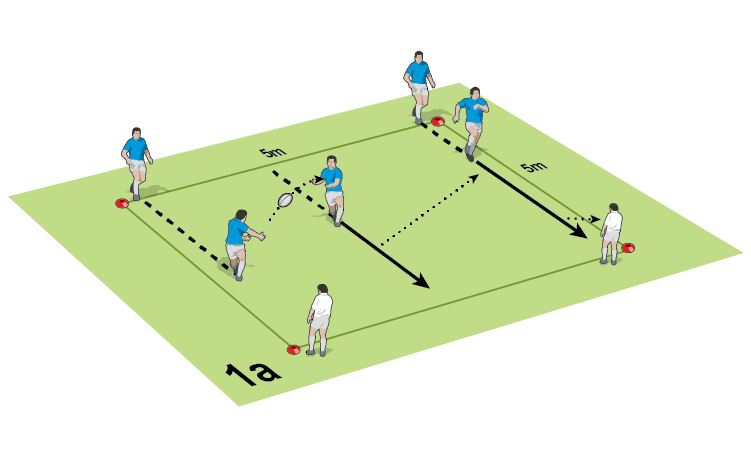
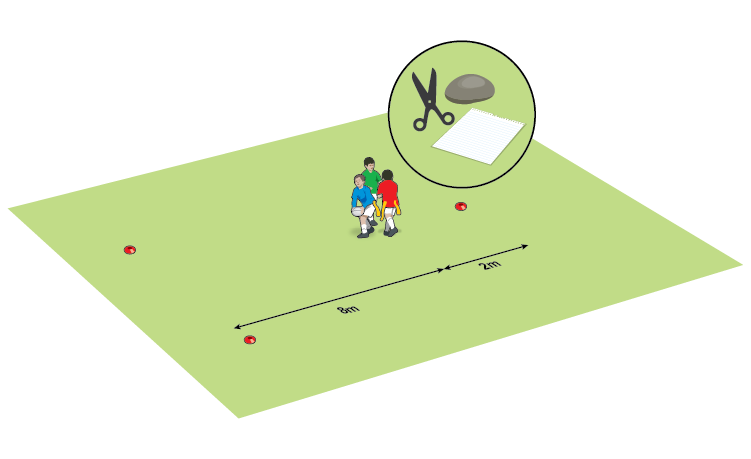
Colin Ireland created a ’miss pass’ training session.
The miss pass is a long pass which skips one player, with the missed player drawing a defender in the process.
Like all passing plays, it’s only relevant when they are defenders in front of the passers. Otherwise, what are the triggers for the pass? And why use a miss pass when you could use two short passes?
There are two possible reasons for practising initially without defenders:
- New techniques: Players can be introduced to a fresh technique. Here, the techniques are long passes to moving targets and running lines to draw defenders.
- Confidence: Build some confidence in the technique. Like jumping into the sea at the start of a summer holiday, the second time you do it, you will remember that, after the initial shock, it will be lovely afterwards. Some repetitions without pressure can give a player a feel for what’s needed.
Unfortunately, some coaches don’t move on from this. Again, this is for two reasons.
Firstly, with defenders in the way, there will be mistakes. That will make training look messy. Messy training isn’t regarded as a sign of progress.
The second reason has some merit, though. With defenders in the way, and mistakes made, the players will become disheartened. Demotivated players will then make more mistakes and the technique won’t be honed into a skill.
Yoko Ono, who knows diddly squat about rugby (and, according to some, even less about life), once said: "Stop waiting". She’s right about that.
We can’t wait until the game to put pressure on the players. They must be prepared to make mistakes in training, and so push the technique so it can turn into a repeatable skill.
Our role as coaches is to create an environment where players accept that.
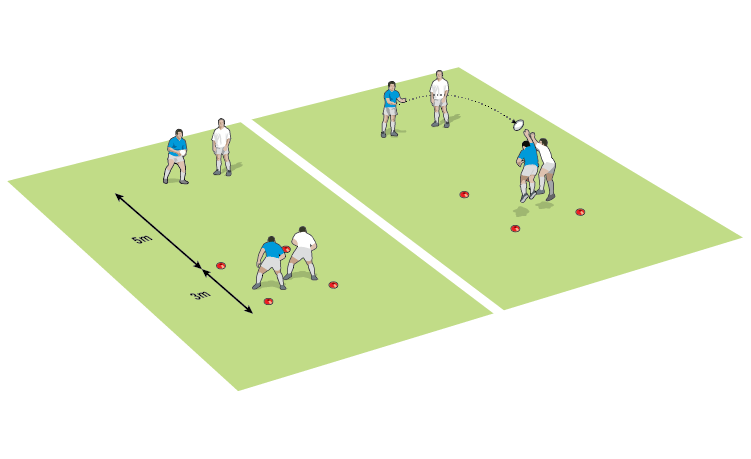
Colin’s session moves us along that path. It has ’defenders’ in one sense – he uses pads and tubes as static defenders. The attackers now have some form of visual clue to change their angles.
Of course, it’s not completely realistic. However, if you manipulate the pads, you create a realistic ’tackle’ line, so the players don’t overrun the passes.
The tackle line represents the likely point at which each defender would reach the attack.
The session is a stepping stone, but also useful if you don’t have enough players at training to act as defenders.
Extend that thinking to team runs, especially on matchdays.
When the backs and forwards split, if you are running through your plays, why not put out some cones on the ground to represent the tackle line.
Be a more effective, more successful youth rugby coach
- Win more games, without sacrificing the crucial element of fun
- Develop every player, regardless of vast differences in ability
- Run a respected, professional programme - even with a full-time job and limited time
Limited time - use code WELCOME40 to save 40% on membership
or register to receive our weekly newsletter, and a free coaching e-book
Already subscribed? login

Dan Cottrell
Latest Issue
Subscribe Today
Subscribe Today

Newsletter Sign Up

Coaches Testimonials

Gerald Kearney, Downtown Las Vegas Soccer Club

Paul Butler, Florida, USA

Rick Shields, Springboro, USA

Tony Green, Pierrefonds Titans, Quebec, Canada
Subscribe Today
Latest Issue

Be a more effective, more successful rugby coach
In a recent survey 89% of subscribers said Rugby Coach Weekly makes them more confident, 91% said Rugby Coach Weekly makes them a more effective coach and 93% said Rugby Coach Weekly makes them more inspired.
Get Weekly Inspiration
All the latest techniques and approaches


Rugby Coach Weekly offers proven and easy to use rugby drills, coaching sessions, practice plans, small-sided games, warm-ups, training tips and advice.
We've been at the cutting edge of rugby coaching since we launched in 2005, creating resources for the grassroots youth coach, following best practice from around the world and insights from the professional game.
