
 close
close


 LOGIN
LOGINSupport: the hardest principle
Editor Dan Cottrell adds further context to two sessions.


Support skills are rarely trained in isolation.
Any passing drill requires some form of support. A chain of passes needs the second and third receiver to adjust their runs, based on not just the original ball carrier, but also the next ball carrier.
That players at all levels still overrun, or find themselves disconnected from, their team-mates in training exercises shows these skills aren’t easily defined. So, we must be more astute in the way we set up our exercises.
The other problem is that support is an essential product of handling or continuity skills.
We might run a passing exercise focusing on catch and pass, or fixing defenders. But the angles and timing of the supporting players will be of secondary concern.
Of course, we will ask for more depth or pace onto the ball. Yet, we give the players only some rudimentary ideas on what that might look like, or how to improve it.
Continuity skills, which are about recycling the ball from the contact area, tend to focus on the outcomes, or the processes in the last metre. Again, we do think about the players ’getting there’, but don’t spend enough time on the thinking behind it.
One solution has been to develop patterns and pods. These are pre-ordained running lines and roles, so enough players arrive in support of the ball carrier.
More recently, some coaches have tried to avoid using too much structure, encouraging players to react to what’s in front of them.
In the 1990s, French coaches liked to think about the ’family’ of the ball, with non-ball carriers making decisions based on their relationship to the ball: Were they in close support or did they need to realign for the next play?
Develop players’ awareness in two ways...
Immediate support
The players think they will be receiving the ball next, or helping to secure the ball should the ball carrier go into contact.
That won’t be just one player – it could be a player either side, and one behind. They will be focused on defenders in a narrow visual arc.
Some coaches have forced this by trying to think of playing in diamond shapes.
Wide support
The players think they will be receiving a pass from the next receiver, or in the next phase.
They will have to look at the opposition across the field, and adjust their depth and width.
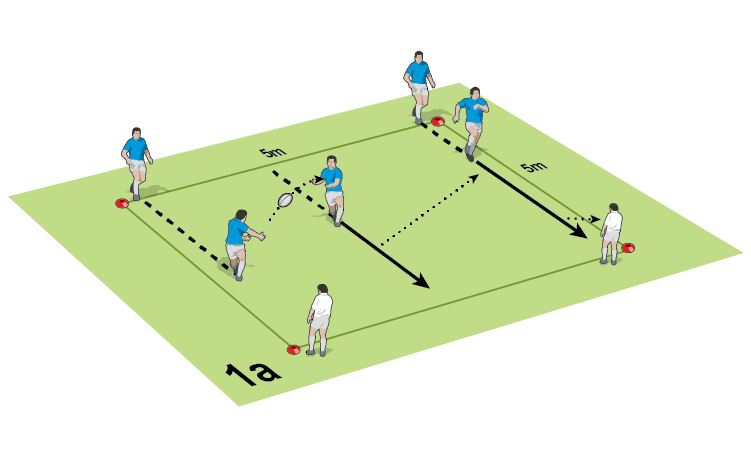
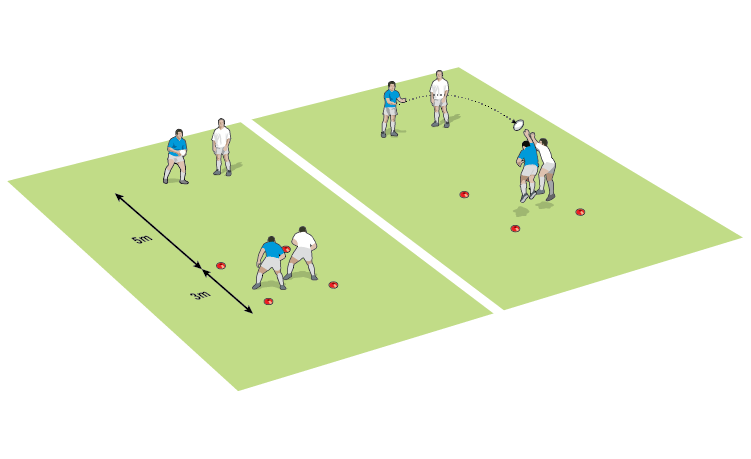
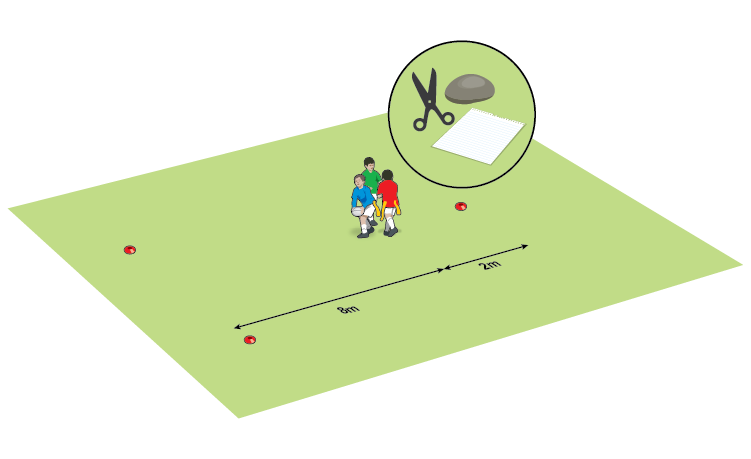
In these two practices I’m looking at immediate support – first, at the support skills of the very first receiver, and then at how to be in position to be the next support player.
Can you make your games even faster?
Sometimes you wonder why you didn’t think of a trick to improve your training before.
I’ve been using more and more games in training focused on improving skills in more intense decision-making environments.
Of course, the players love them. And I sense there’s a real buzz from the competition.
But, more recently, I’ve been adding elements to make the players become more attuned to transition – moving from attack to defence, or vice versa.
It’s hard to create ’turnover’ situations, other than when they happen naturally. I’m certainly not an enormous fan of throwing in a new ball to create a different point of attack. That’s fine for certain games, but not so good for turnovers.
Turnovers are best replicated around the ball focus. That’s where players are looking in.
When the ball is turned over, you need them to look out quickly from the turnover and be aware.
I now play games with more turnover opportunities. That can come from natural circumstances, like dropped balls or interceptions.
If you are using touch rugby, you can change the rules a little bit. For example, if two defenders touch the ball carrier at the same time, the ball carrier must go to ground, and the defenders can grab the ball.
The reason the game becomes faster is that there’s more turnover opportunities, and the players have to react quickly.
I’ve added in some of the other ideas around these thoughts in this article, plus some ways to make your players think differently.
The top teams realise that turnovers are an excellent opportunity to score from. They are even comparing their times against their rivals to see who’s fastest. No prizes for guessing who wins on that count.
Related Files

Dan Cottrell
Latest Issue
Subscribe Today
Subscribe Today


Newsletter Sign Up

Coaches Testimonials

Gerald Kearney, Downtown Las Vegas Soccer Club

Paul Butler, Florida, USA

Rick Shields, Springboro, USA

Tony Green, Pierrefonds Titans, Quebec, Canada
Subscribe Today
Latest Issue

Be a more effective, more successful rugby coach
In a recent survey 89% of subscribers said Rugby Coach Weekly makes them more confident, 91% said Rugby Coach Weekly makes them a more effective coach and 93% said Rugby Coach Weekly makes them more inspired.
Get Weekly Inspiration
All the latest techniques and approaches


Rugby Coach Weekly offers proven and easy to use rugby drills, coaching sessions, practice plans, small-sided games, warm-ups, training tips and advice.
We've been at the cutting edge of rugby coaching since we launched in 2005, creating resources for the grassroots youth coach, following best practice from around the world and insights from the professional game.
