
 close
close


 LOGIN
LOGINSlice and block
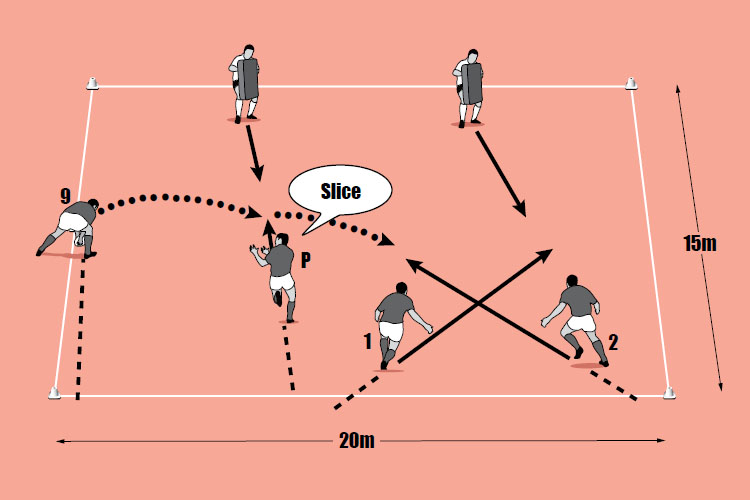
This session builds up a phase play move to break down an organised defence, focusing on the space outside their 10. It is easy to set up but requires a good level of skill to run the right lines and time runs. However, the angles should give your team a chance to get over the tackle line, if not break it completely.
Warm up time: 5-7
Session time: 8-10
Development time: 10-15
Game time: 10-15
Warm down time: 5-8
What to think about
This is a play that can be run by backs and forwards. It needs constant repetition in training to allow players to naturally adjust in matches to meet the changing shape of the defence. Therefore, the session puts the building blocks in place and can be run as part of the warm-up section of training in future sessions. In training, you can have several lines of players waiting to be fed the ball, so it can move through one set after another. Ideally, the pivot player is a handling decision maker (like a 10 or 12).set-up
- First receiver (pivot player): Call the play, attack the line, then turn slightly to see the runners. Be prepared to pass to either player or go yourself.
- Second and third receivers: Adjust your starting positions when you hear the call. Look at the defence before you look at the pivot player. Attack the line with conviction and expect the ball.
What you get your players to do
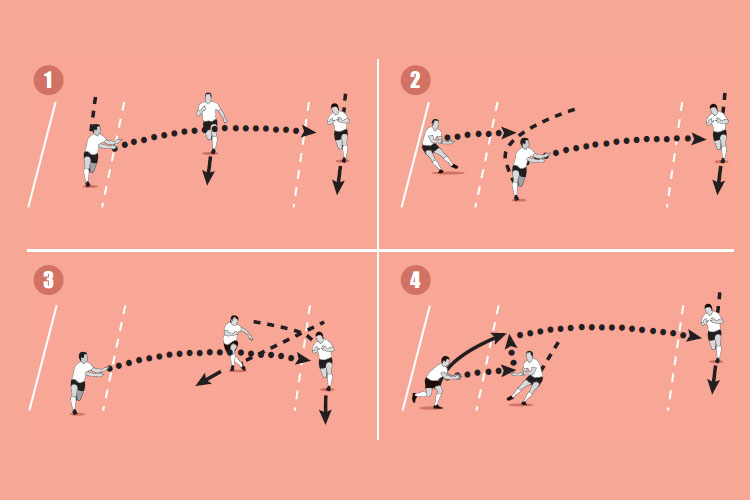
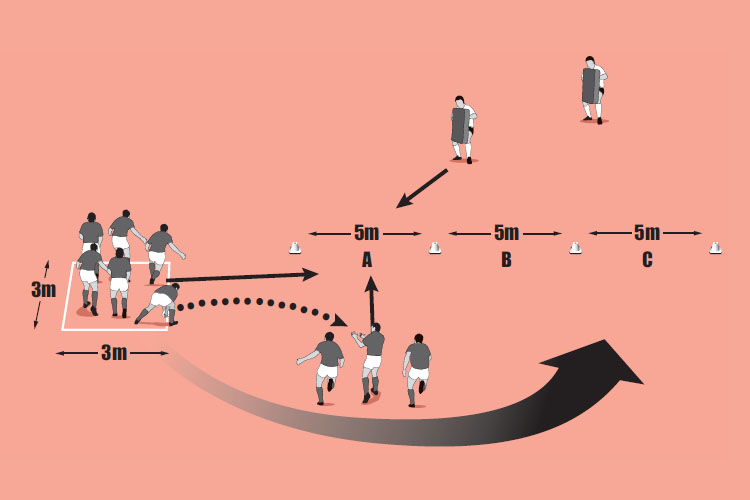
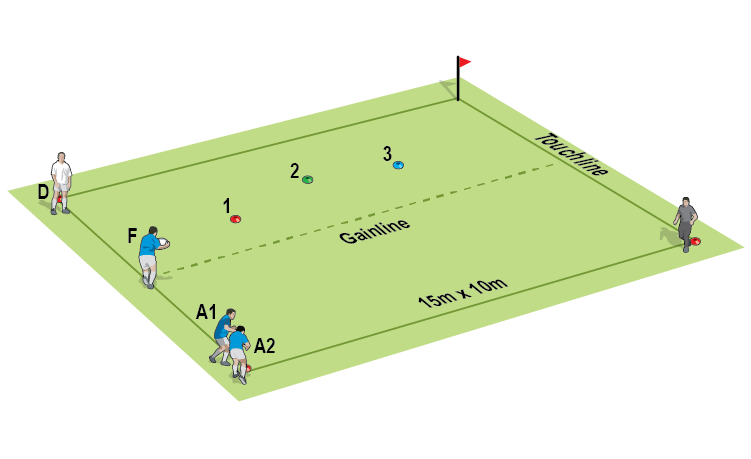
Put a feeder at the side of a 20m x 15m box, and two ruck pad holders at the far end facing three attackers (see picture 1). The first ruck pad holder focuses on the pivot player (P, the first receiver), the second ruck pad holder on either of the other two (1 and 2). The pivot player calls either a “slice” or a “block”. If he calls a slice, 1 runs out, 2 runs in, with 1 going before the 2. He then passes to the player who seems to be running to the space. On the block play (see picture 2), 2 runs in front of 1, with either a late pass behind 2 to 1, an early pass to 2 who passes to 1 on the switch or a late pass to 2. Change sides to try off the other hand.Be a more effective, more successful youth rugby coach
- Win more games, without sacrificing the crucial element of fun
- Develop every player, regardless of vast differences in ability
- Run a respected, professional programme - even with a full-time job and limited time
Subscribe for full access
Or register and unlock 2 free articles,
receive our weekly newsletter, and
get a FREE coaching e-book.
Or if you are already a subscriber login for full access.

Dan Cottrell

Latest Issue

Subscribe Today
Subscribe Today
Newsletter Sign Up
Coaches Testimonials

Colin Shaw

Gary Lee Heavner
Subscribe Today
Latest Issue
Be a more effective, more successful rugby coach
In a recent survey 89% of subscribers said Rugby Coach Weekly makes them more confident, 91% said Rugby Coach Weekly makes them a more effective coach and 93% said Rugby Coach Weekly makes them more inspired.
Get Weekly Inspiration
All the latest techniques and approaches


Rugby Coach Weekly offers proven and easy to use rugby drills, coaching sessions, practice plans, small-sided games, warm-ups, training tips and advice.
We've been at the cutting edge of rugby coaching since we launched in 2005, creating resources for the grassroots youth coach, following best practice from around the world and insights from the professional game.
