
 close
close


 LOGIN
LOGINAggressive drive tackle

Aggressive tackles at the sides of rucks stop opponents making easy ground. The players who protect these areas need to be in position quickly. In training and games they are often present but not ready to tackle. They need to make a specialised tackle too – the “drive tackle”.
Warm up time: 5-7
Session time: 8-10
Development time: 8-10
Game time: 15-20
Warm down time: 5-7
What to think about
You and your team may have specific names for the players who are defending closest to the rucks: “posts”, “pillars”, “guards”, “A and B” and so on. These names are not aggressive enough. This player has to be spring loaded to “drive tackle” anything that comes towards him. The “drive tackle” is not a conventional tackle because the ball carrier will not be running as they would in open play. It is likely that the ball carrier’s body will be parallel with the ground. The tackler is positioned as he would be to engage in a scrum. Some will favour the American Football-style three-point stance, with one hand on the ground. Others will be a little more upright to read the play.set-up
- Set yourself square and low next to the ruck.
- Get under the ball carrier and drive them back into the ruck if they come towards you.
- If they are lower than you, drive on top of them and into the ground.
What you get your players to do
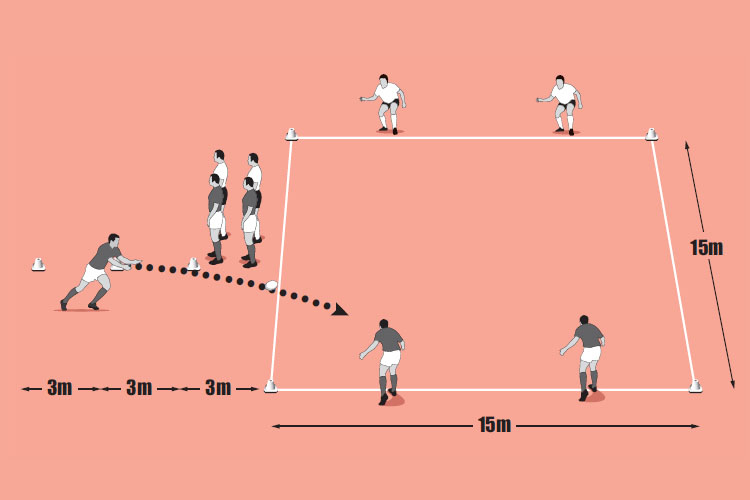
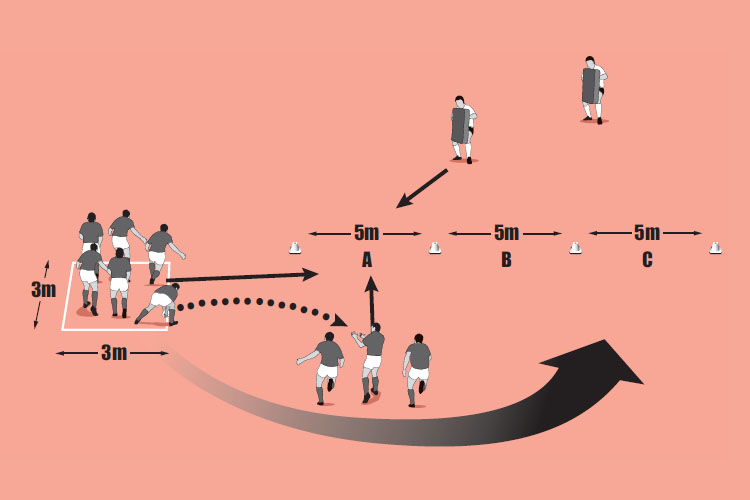
Set out the cones into three ruck shapes with a ball behind each ruck. Put two defenders inside a separate box. Make two ruck pad holders and another player run to one of the rucks, with a ruck pad holder either side of the ruck. In the meantime the defenders run out as well to defend the edge of the ruck. When the non-ruck pad holder dips to touch the ball, both defenders and pad holders move forward and make contact. The defenders aim to drive the pad holders backwards. Develop by making the ruck pad holders go to the same side, so the defenders have to adjust.Be a more effective, more successful youth rugby coach
- Win more games, without sacrificing the crucial element of fun
- Develop every player, regardless of vast differences in ability
- Run a respected, professional programme - even with a full-time job and limited time
Subscribe for full access
Or register and unlock 2 free articles,
receive our weekly newsletter, and
get a FREE coaching e-book.
Or if you are already a subscriber login for full access.

Dan Cottrell

Latest Issue

Subscribe Today
Premium Books

Subscribe Today
Newsletter Sign Up


Coaches Testimonials

Colin Shaw

Gary Lee Heavner
Subscribe Today
Latest Issue
Be a more effective, more successful rugby coach
In a recent survey 89% of subscribers said Rugby Coach Weekly makes them more confident, 91% said Rugby Coach Weekly makes them a more effective coach and 93% said Rugby Coach Weekly makes them more inspired.
Get Weekly Inspiration
All the latest techniques and approaches


Rugby Coach Weekly offers proven and easy to use rugby drills, coaching sessions, practice plans, small-sided games, warm-ups, training tips and advice.
We've been at the cutting edge of rugby coaching since we launched in 2005, creating resources for the grassroots youth coach, following best practice from around the world and insights from the professional game.
