
 close
close


 LOGIN
LOGIN11 ways to improve your scrum-half's pass
Former international 9 and now scrum-half coaching guru, Shaun Perry, tells us what he looks for when he’s helping players improve their passing.
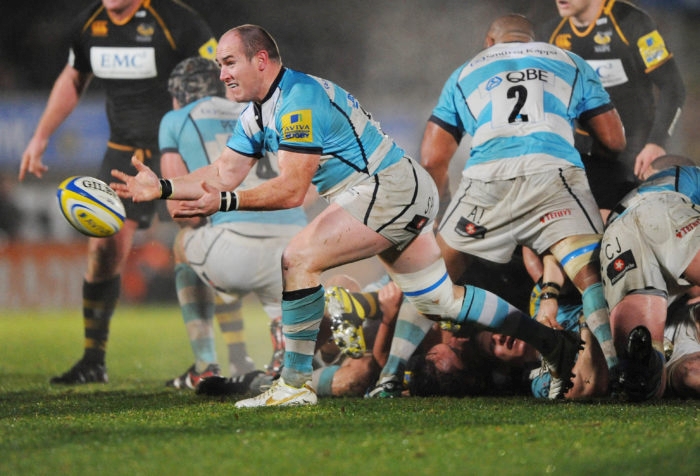
Feet first
A good pass starts with solid foundations and that means the feet have to be in the right position. Of course, it’s not always possible to do this in the context of the game, but there’s a standard position if the scrum-half is passing away from the base of a ruck or scrum.
The lead foot, that’s the foot that’s closest the destination of the pass should be pointing towards the target. Now, that’s not exact, but it has to be in that direction. If it’s not turned enough, then the passer is likely to be over-rotating their upper body which leads to a reduced chance of accuracy.
The passer needs to have a sense of passing down a channel, with everything moving towards that target.
From a coaching point of view, the emphasis on the feet takes into account the fact that many 9s I start coaching tend not to place their feet correctly if they have a chance. That’s why I spend time on developing this passing posture. It adds another tool to their toolbox.
As a 9, you are faced with many pictures when you approach the ball and consider which pass to use. Better footwork gives a better tool to use.
Training the feet
To coach this, I give the 9 different pictures. I bounce the ball off a trampet or have the 9 facing away from me, turning around as the ball is rolled or placed. Each time the 9 has to adapt accordingly. So, as they see the picture, they are adjusting their feet and hand position to give the best chance to pass accurately.
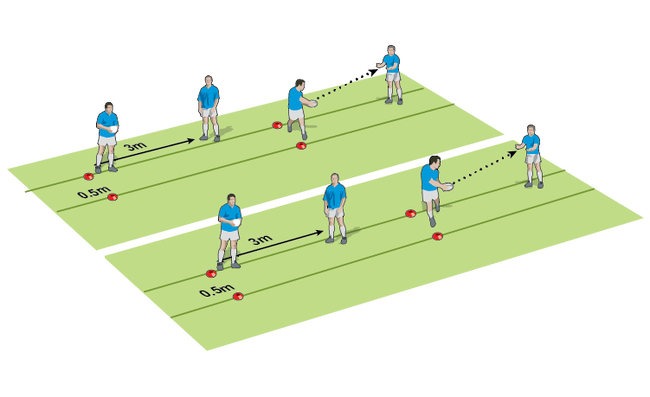
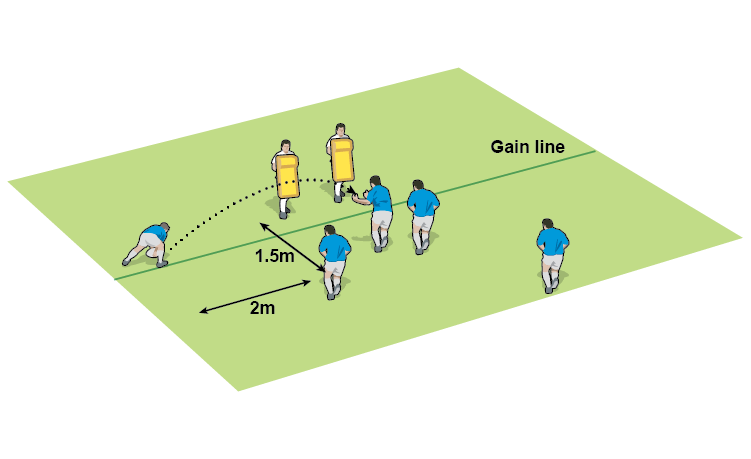
There always needs to be a target, either a static or moving receiver. Again, the 9 needs to see the picture and adapt their feet. If it’s just one player working with the coach, then we can use tackle tubes or the rugby posts as a target. I use different targets so the player isn’t always passing to the same spot.
Hand placement
After footwork, hand placement is the next key. The dominant hand is the back hand or the hand furthest from the target. On a “Gilbert” ball this hand would be on the G, I and L towards to the back end of the ball. Place the other hand lightly on the ball. It is used more as a guide than to impart power.

Rolls off little finger last
When the ball is passed, the hands follow through to the target. The back hand ends up with the palm facing the sky. The hand counterintuitively rolls under rather than over the ball. However, give the player the sense of the finish, and let them come up with the solution.
Ideally, when finishing the pass, the 9 doesn’t cross the wrists. Again, while it’s preferable, they don’t need straight arm finish. To help get the feel and the best finishes, I would do lots of one hand passing with the player.
Different passes from different hands
If you look at the best of the best, like Danny Care, they have lots of different passes. Often their right-hand pass will be different to their left-hand one. Therefore, coaching the pass is a lot about the outcome more than the process.
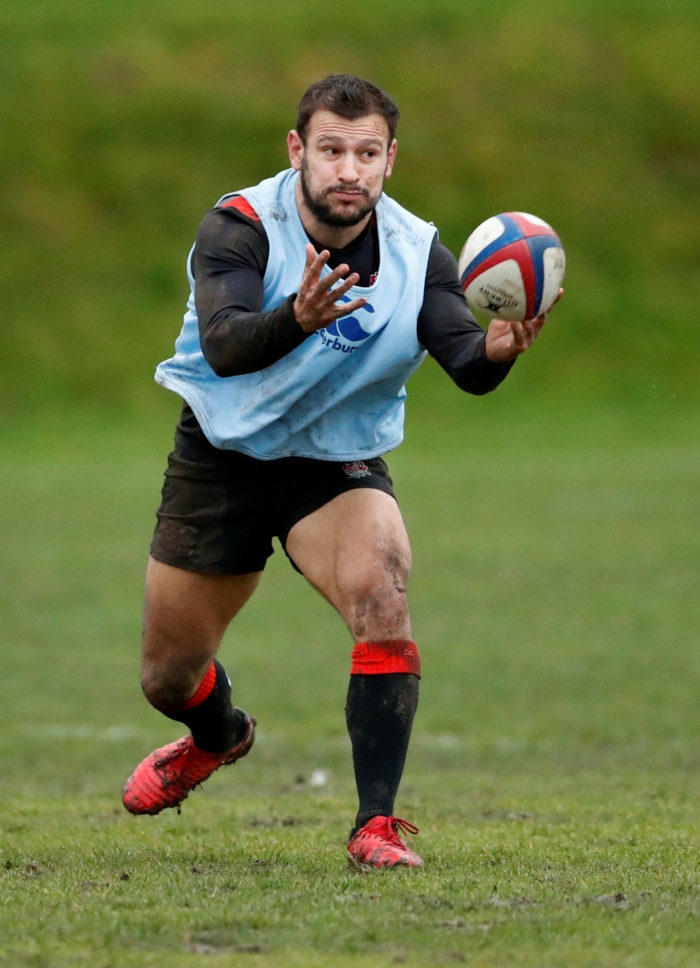
You ask the players about how the pass felt when it goes well and not so well. You help them discover what adjustments to make. It takes a lot of repetition. However, that’s not lots of the same situations. It needs to be mixed up. I would set up lots of different scenarios in the training area, replicating possible situations to pass away from.
The 11 ways to improve your scrum-half's passing
- The core foot position
- Avoiding over-rotation
- Adapting the feet according to the situation
- Always have a passing target
- Keep changing the target in training
- Dominant hand placement
- Counterintuitive spinning
- Rolling the ball off the little finger
- The best finish position, though not always
- Different hands, different methods
- Mix up the scenarios
Be a more effective, more successful youth rugby coach
- Win more games, without sacrificing the crucial element of fun
- Develop every player, regardless of vast differences in ability
- Run a respected, professional programme - even with a full-time job and limited time
Subscribe for full access
Or register and unlock 2 free articles,
receive our weekly newsletter, and
get a FREE coaching e-book.
Or if you are already a subscriber login for full access.

Shaun Perry
Latest Issue
Subscribe Today
Subscribe Today
Newsletter Sign Up
Coaches Testimonials

Colin Shaw

Gary Lee Heavner
Subscribe Today
Latest Issue
Be a more effective, more successful rugby coach
In a recent survey 89% of subscribers said Rugby Coach Weekly makes them more confident, 91% said Rugby Coach Weekly makes them a more effective coach and 93% said Rugby Coach Weekly makes them more inspired.
Get Weekly Inspiration
All the latest techniques and approaches


Rugby Coach Weekly offers proven and easy to use rugby drills, coaching sessions, practice plans, small-sided games, warm-ups, training tips and advice.
We've been at the cutting edge of rugby coaching since we launched in 2005, creating resources for the grassroots youth coach, following best practice from around the world and insights from the professional game.
