
 close
close


 LOGIN
LOGINRugby Coach Weekly is the largest digital resource for youth coaches, trusted by 15,000+ coaches, teachers and parents every month.
Get access to
- 2000+ drills and games
- 350+ ready-made practice plans
- Expert coaching advice
- Training sessions for players from U6 to U17+.
Performance pads for player engagement
Here’s how I used an evidence-based approach to reflection to give my team realistic and practical ways to improve their performance. By Harry Titley, Director of Rugby, Burton RFC


Recently, I read an article by former England football manager Gareth Southgate, and one point in particular resonated with me. He explained that when he was appointed to the role of England Head Coach, he wanted the title to be changed to England Manager. He then broke down what the term “manager” really represents, which prompted me to reflect on my own role as Director of Rugby.
I see my role as being made up of three core elements.
1. Leadership: operating visibly within the club and shaping the environment and culture.
2. Management: bringing together people, stakeholders, and a group of committed players, ensuring collective purpose is always placed ahead of individual ego.
3. Coaching: whistle in hand, on the training pitch, preparing teams to exploit opponents and developing the abilities of each player.
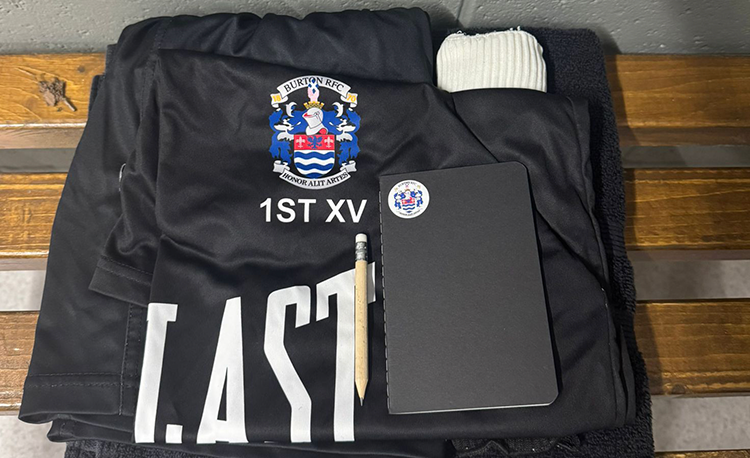
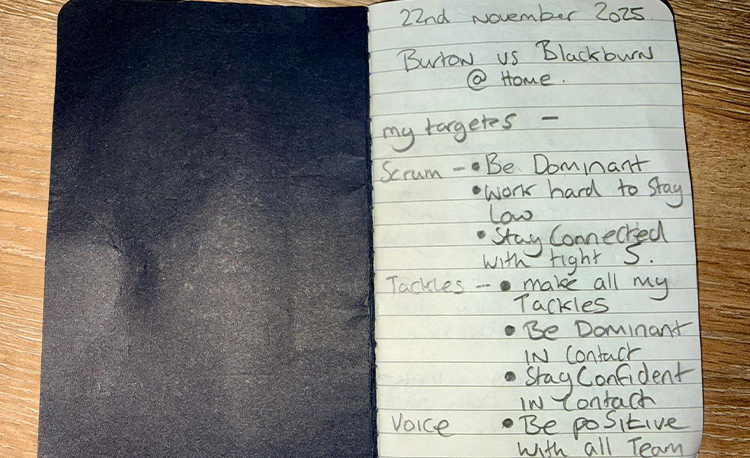
To bring all of these elements together, I introduced the ‘Performance Pad’, a personal journal carried by every player and embedded into their weekly routine.
It is a tool for self-awareness, accountability, and purposeful performance, rooted in sports psychology.
Crucially, it is not homework, and it is not a coach’s tick-box exercise.
How it works
Each player receives a notebook (it’s not glamorous; it’s from Amazon!) with a Burton RFC sticker on the front. The players are encouraged to complete their notes before and after each game.
Pre-match questions
On a Friday night, I send out the following questions for players to answer (questions may vary):
- What is my standout individual goal for this game?
- How will I know if I’ve achieved it?
- What do I need to do to make it happen?
- What one strength do I want to show today? (Your unique selling point (USP))
These tasks should take no more than a few focused minutes. It creates a moment of intention and a clear lens through which to view their performance.
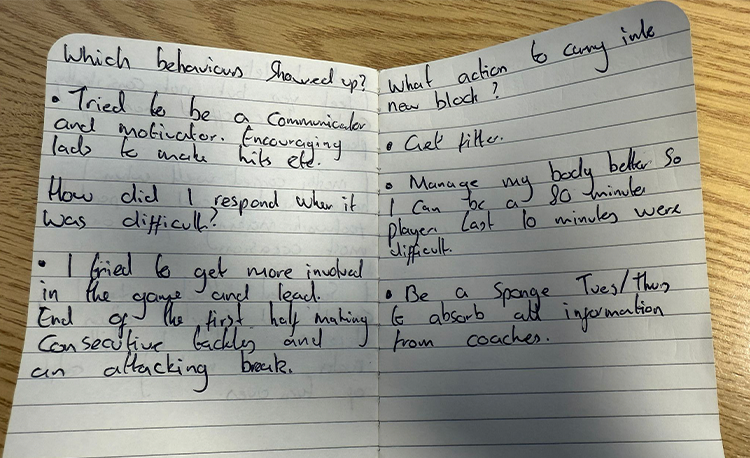
After the game, players reflect again using prompts that close the loop:
- Did I achieve my goal, and how do I know?
- Did I act in ways that supported my intention?
- What went well, and what needs to improve next week?
These entries stay personal. They aren’t handed in like homework.
They do, however, serve as a basis for meaningful conversations between coaches and players during the week: What was your target? Did you hit it? How do you know? What’s your next focus?
I’ve also extended the Performance Pad to our substitutes, whom we now refer to as our IMPACT. They’re challenged to be intentional about the influence they can have on the game.
- What type of impact do I want to make when I enter the field?
- What does that impact look like?
- How does my role shift depending on the state of the game? If we’re chasing the match, what can I bring? If we’re in front, how do I help close it out?
The IMPACT are also asked to agree on three shared values that define how they operate and how they can support the starting XV. Those values shape how they prepare, how they support one another, and how they inject energy and clarity when called upon.
Why we do it
Research across elite sport shows that athletes who engage in structured reflection and goal-setting outperform those who don’t.
This is not necessarily because they’re more talented, but because they think differently about the game and their performance.
Structured reflection also aligns with Kolb’s learning cycle: perform, reflect, learn, improve. By deliberately revisiting performance, players accelerate their learning curve and deepen their tactical and emotional insight.
If you have read The Pressure Principle by Dave Alred, you will be familiar with T-CUP: Thinking Correctly Under Pressure. By grounding players in clear pre-game intentions and structured post-game reflection, the Performance Pad helps develop cognitive resilience.
When mistakes occur, as they inevitably do in rugby, players who regularly reflect are far better equipped to reset, adapt, and execute with clarity.
The ability to reset is crucial for us. On average, there are only around 30 minutes of ball-in-play time during a match, leaving roughly 50 minutes of thinking time. That’s 50 minutes for contemplation, doubt, and over-thinking to creep in. Having clear, predetermined targets allows players to refocus and reset, bringing them back to the present moment, the task, the objective, and the outcome.
Do they work?
The Performance Pads immediately sparked curiosity. Before any considered reflections had been written, a few expletives appeared on the pages, which, if nothing else, confirmed they were being used!
Not every player chooses to use them, and that is absolutely fine. However, those who do are noticeably focused and motivated.
Throughout the week, I regularly receive messages from players sharing their thoughts and reflections, often asking for further input. I also see players writing in their Pads before and after games. Some players who were not present when the Pads were first handed out have since approached me to request their own copy, a clear sign of buy-in.
“The Performance Pad builds a squad of players and coaches who think, reflect and improve”
One of the most noticeable changes I have observed is our improved resilience to being ‘rattled’. This was particularly evident in a recent local derby against Derby. With two strong sides locking horns, the Performance Pads proved their value during the half-time team talk.
Derby, sitting bottom of the table, had nothing to lose against a Burton side placed third and riding a nine-game winning streak. They succeeded in getting under our skin in the first half, and we went into the break narrowly leading 12–10.
The half-time message was simple: revisit your targets in your Performance Pads, identify your USP, and focus on delivering it. If everyone showed their USP in the second half, the result would take care of itself.
The response was outstanding. Our second-half performance was sharper, more focused, and far more efficient. We remained composed, refused to be frustrated by the opposition, and committed fully to the process, and that made all the difference. Burton 39 - 17 Derby.
Related Files
Accountability
The Performance Pad builds a squad of players and coaches who think, reflect and improve. I’ve started using the same reflection process for myself that I ask of the players, and it’s been one of the most grounding changes I’ve made as a coach. Going into a game with clear coaching intentions keeps me focused, on task and accountable for my own behaviour on the sideline. Instead of being reactive to every moment, I’m more deliberate about what I say, when I say it, and how I support the group. It’s easy as a coach to talk about standards and performance without applying the same discipline inwardly, but writing things down and committing to them forces honesty.
The biggest benefit, though, comes after the game. I take losing personally, and like many coaches, I can be quick to question my ability to lead, manage and coach when results don’t go our way. Having my own targets means that even in defeat, I can still find genuine satisfaction if I’ve ticked off one or two of them. Those small wins matter. They help me separate the outcome goal from the performance goal and remind me that progress isn’t always reflected on the scoreboard. Over time, those reflections have become a way of keeping perspective, tracking my own development, and making sure that a tough result doesn’t derail my belief or my direction as a coach.

Dan Cottrell
Latest Issue
Subscribe Today
Subscribe Today

Newsletter Sign Up


Coaches Testimonials

Colin Shaw

Gary Lee Heavner
Subscribe Today
Latest Issue
Be a more effective, more successful rugby coach
In a recent survey 89% of subscribers said Rugby Coach Weekly makes them more confident, 91% said Rugby Coach Weekly makes them a more effective coach and 93% said Rugby Coach Weekly makes them more inspired.
Get Weekly Inspiration
All the latest techniques and approaches


Rugby Coach Weekly offers proven and easy to use rugby drills, coaching sessions, practice plans, small-sided games, warm-ups, training tips and advice.
We've been at the cutting edge of rugby coaching since we launched in 2005, creating resources for the grassroots youth coach, following best practice from around the world and insights from the professional game.
